
Tuesday, November 10, 2009


Post with the Most on Tom Paine's Ghost!
Get your keyboards dusted off and ready to take part in a good ol' fashion competition of creativity. The first annual Post with the Most on Tom Paine's Ghost is underway. Read the details here. A cash prize and glory as long as the internet lives await the winner.
The Astronomist shows the first inkling of interest bringing our collective attention to a dark period in the history of the universe.
"My own research centers around the end of the cosmic dark ages, reionization.
The cosmic dark ages are a period of time between about 300,000 and 1
billion years after the big bang where there were no stars or galaxies.
During reionization the first stars and galaxies formed and the modern
era of galaxy evolution began. Quite and amazing analogy to the
cultural renaissance. Perhaps I should write about this..."
Monday, November 9, 2009
Happy Birthday Carl!
Today is Carl Sagan's 75th birthday. May his spirit live on. A real world Spock, Carl Sagan represents so much to anyone lucky enough to catch even a little of his infectious enthusiasm. My fascination with Carl did not begin, as it should have, when I watched Cosmos in middle-school earth science class, but rather when I spent a year of weekends in Ithaca, NY talking to people that had lived around him and knew the man. His existence like the existence of so many bright stars shined through the smiles of people's faces when you asked about him. He is legend for his passion. Inspiring countless scientists to pursue their own passion for critical thinking and skepticism while balancing these things with a sense of wonder and fantastic speculation. Dragons of Eden was a transformative book for me having the same kind of effect as Zen and the Art of Motorcycle Maintenance and Siddhartha. Recommended to me by one of my first scientific mentors this walk through the human mind was unparalleled for me in clarity and intrigue. Attempting to explain and rationalize the seemingly impenetrable world of emotions by suggesting biochemical origins and charting out evolutionary pathways the brain's systems may have arisen through brought a sense of possibility. Thinking it possible that someday humans might understand their own physico-chemical make up well enough to predict and prevent suffering made it seem worth pursuing science as a life's goal.
For me his reach went further than Ithaca, eventually following me to Fort Collins, Colorado. Here in my second year of graduate school I was lucky enough to meet and discuss some big ideas in biology with Lynn Marguilis, once married to Carl. She was visiting as a Monfort Scholar and gave two lectures, one on the Gaia Theory and one on the current state of endosymbiont thought. The most striking of the information presented there still echos in my memories. She talked about green worms that had actually incorporated photosynthsizing algae under their skin to provide food for themselves in-house! The first inklings of a plant-animal hybrid. After her second lecture she gave an extra discussion session which only a handful opted to attend. Here we were able to discuss the rise of the eukaryotes for hours almost one on one. While we talked I was tempted to ask her about Carl but kept the conversation centered on science. As the first person to really communicate broadly the endosymbiont theory she and I speculated on the origins of histones and their role in keeping distinctions between the eukaryotes and their helpful passengers - the mitochondria and the chloroplasts. The smile she had on her face as she let her biological wisdom flow into open ears came from herself, yes, but I could not help but think Carl's spirit and the synergistic conversations they must have had. Their son Dorian Sagan continues in his father's path telling the world about amazing science as it happens.
If you have not experienced Carl please let him speak for himself.
Thursday, November 5, 2009
Monday, November 2, 2009
Response to Robert Carter
By Kristopher Hite
This rant was composed after reading about a "geneticist" named Robert Carter who recently gave a three part lecture series in Fort Collins, Colorado on how Darwin was wrong and "modern science" disproves evolution.
This rant was composed after reading about a "geneticist" named Robert Carter who recently gave a three part lecture series in Fort Collins, Colorado on how Darwin was wrong and "modern science" disproves evolution.
Intelligent design proponents sure know how to put on a show. Sad to see that they really never talk about actual science. I'd like to know how our collective modern understanding of genetics, species, biochemical processes, proteins, plate tectonics, and sedimentation disprove evolution. To me the scientific method has uncovered an enormous amount of data to back up some of Darwin's fundamental postulations.
Evolution by means of natural selection through descent with modification. That was Darwin's novel concept and that has indeed withstood the test of time. Emerging information is constantly incorporated into the overarching theories that make up the cornerstones of modern science. And evolution is one of these cornerstones.
Since I opened by complaining that Robert Carter did not anywhere in this article talk about any actual science let me follow my own advice. While studying biochemistry it is impossible to avoid making some observations that can be very well explained by evolution. This happened for me recently while contemplating the molecules known as the porphyrins. These are the conjugated macro-cyclic rings that hold iron in its place in hemoglobin (the proteins in blood that shuttle oxygen around the body). These SAME molecules - the porphyrins - are also used by plants to hold magnesium atoms in place to do some of the key enzymatic reactions converting light energy to chemical energy in the chlorophyll. In both humans and plants the same set of enzymes build the porphyrin molecules though in the end the molecules have different functions. However, when the genetic disease porphyria arises in an animal a strange thing happens. The mal-formed porphyrins revert to their plant function as light harvesters. Indeed these molecules exist as non-functioning metabolites in any animal with a gall bladder. Called bilins these molecules serve no function other than to make the bile the green color. But in plants the "phycobilins" actually decorate the thylakoid membrane within the chloroplast and help harvest and subsequently direct light energy into the photo-centers (where the reactions that turn light energy into chemical bonds happen). In a human patient with porphyria these bilins build up to high concentrations in the skin, blood, urine and tooth enamel.
 The tooth enamel is where an observer can see these molecules revert to their evolutionary heritage. When UV light is shone on the teeth of a patient of porphyria, the teeth glow! The mal-formed porphyrin molecules are reverting to their plant function - harvesting light energy! In this one instance we see that the biochemistry of humans and plants are one and the same.
We do have a common ancestor with all life in fact, and the keys to understand this fact lie in the base paired code of our genome. We can see what we call homologs. Basically these are genes that are the same in more than one species. But not only that, we can trace back, through molecular phylogeny, certain genes that have duplicated and then diverged in their ultimate function. The porphyrin-containing family of proteins is one example but there are thousands of others. This simple observation blows the "irreducible complexity argument" favored by so many intelligent design proponents, out of the water because it explains how the seemingly infinite complexity of the cell can actually be explained by the emergence of new genetic "concepts" by the process of gene duplication and divergence.
Until a vast majority of the global population can move past this silly debate of whether all living things on earth were created "as is" by an invisible sky-father 6,000 years ago, or the product of millions and millions of years of evolution by natural selection driven by descent with modification, we really can not move forward toward any kind of sustainable future. In fact, if we keep bickering about this nonsensical non-science we will most likely have a real-world rapture of our own making in the form of global resource wars caused by climate refugees, resource depletion, and overpopulation. Only by understanding why the dodo and the dinosaur went extinct can we hope to postpone our own extinction.

Are there Demons in your M&Ms?
This is why Nick and I still need to give our Biochemistry of Halloween lecture.
Read about our attempt to elaborate on some rational explanations of the origins of vampires, witches, and zombies here here and here.
Our talk, originally slated for last Wednesday October 28th, was canceled due to the freak snow storm in Colorado. It was rescheduled for this Wednsday November 4th at 3PM in 101 Pathology at the CSU campus in Fort Collins, CO. If you can't make it we will try to have it up on you tube by Thursday.
Our talk, originally slated for last Wednesday October 28th, was canceled due to the freak snow storm in Colorado. It was rescheduled for this Wednsday November 4th at 3PM in 101 Pathology at the CSU campus in Fort Collins, CO. If you can't make it we will try to have it up on you tube by Thursday.
Saturday, October 31, 2009
Post with the Most
Tom Paine's Ghost is excited to announce
a composition competition.
A $100 cash prize will be awarded for the most aesthetically powerful multi-media blog post.
Post content is limited only by the bounds of imagination.
Keep in mind Tom Paine's Ghost was founded amidst a battle to defend freedom of the press and we hope to echo that theme throughout our pages.
Submissions will be selected and judged on the basis of four criteria:
1. Clarity
2. Originality
3. Integration (at least three forms of media must be utilized, images, text, movies (you tube or vimeo), audio, etc.)
4. Power (the post's ability to motivate readers to action).
Submissions will be accepted until the summer solstice - June 21st, 2010. Please submit a link to your post in the comments section below along with a short note explaining why you feel your post meets the criteria. Selected submissions will be linked in a submission post here at TPG and voted on by our panel of citizen judges. The winner will be announced on July 4th, 2010 and will be notified by email. Whether this is your first post or your one thousandth all submissions will be reviewed.
You may also submit your post in an email to kristopherhite@gmail.com.

The above scene is one of ten panels that adorn the double doors to the octagonal building known as the baptistry in the center of Florence, Italy. In 1401 a competition was held among the sculptors of the day for the privilege of creating these doors. Doors Michelangelo would later dub the "gates of paradise." The use of point perspective and heightened human realism marked the end of the dark ages and the beginning of the Renaissance. As we emerge from eight years of darkness perhaps a competition in the context of New Media can facilitate the evolution of our communication.
~Cheers to revolution via evolution!
~Cheers to revolution via evolution!
For your Perusing Pleasure
The editor of Boneshaker - Evan P. Schneider - has a nice piece in here about his experience as "Landfill"
in this year's Tour de Fat.
The Biochemistry of Halloween: Installment II
 |
| The moon through the cottonwood trees on the Oval at Colorado State University Photo credit - Kristopher Hite |
By Kristopher Hite updated and edited - 10/30/2025
 Mothers and fathers watched the shriveled toes of a poor beggar swing from the gallows. They placed their faith in God that the death of this unfortunate person might take away the torment, fits, and visions that plagued their children. That somehow, through supernatural forces, the sensations of ants crawling underneath skin, delusions of bursting into flames, and frenzied shrieks of terror in the night would cease. As the seasons brought new harvest,s the number of swinging bodies dwindled. But bouts of bewitchment would visit the same locales for centuries.
This was a typical scene in the medieval villages that lined the dank Rhône and Rhine River valleys following the seam of modern-day Germany and France south through Switzerland to the Italian border. Here and in other curiously coincidental microclimates all over Europe, something dark and treacherous lurked in the fields.
 |
| A sclerotium of Claviceps purpurea on a wheat frond. Photo credit - Dominique Jacquin |
During the cold, wet growing seasons, a deep maroon-colored fungus Claviceps purpurea reared its ugly sclerotium amongst the ears of rye. Looking much like the rooster's spur, the killer was given the French name - erogot. When rye was milled, the flour could contain up to 30% ergot by dry weight. And so it goes that the biochemistry of bewitchment had its origins under the millstones of fifteenth-century Europe.
During this age, the peasantry ate an enormous proportion of the darker, cheaper rye bread; upwards of three pounds a day. As the alkaloids made by the ergot found their way into the blood and brains of those apparently seized by demons, the unaffected were left to assume they had been bewitched. The linguistic fossil preserved in the very word - seizure - describes the uncontrolled fits that the affected person displayed. A condition known at the time as "St Anthony's fire" (aka Ignis Sacer) did not become known as ergotism until 1853 when the clinical connection to the mycotoxins was finally made.
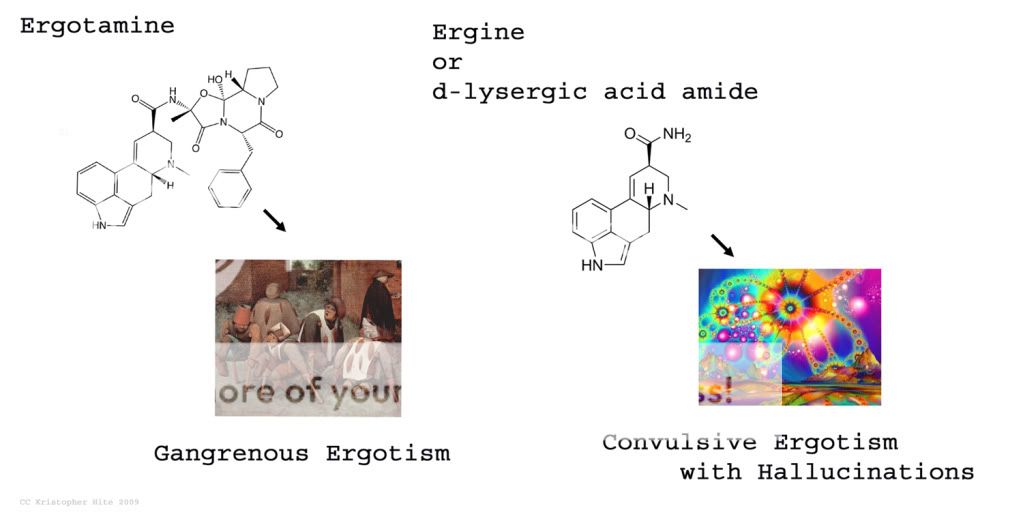
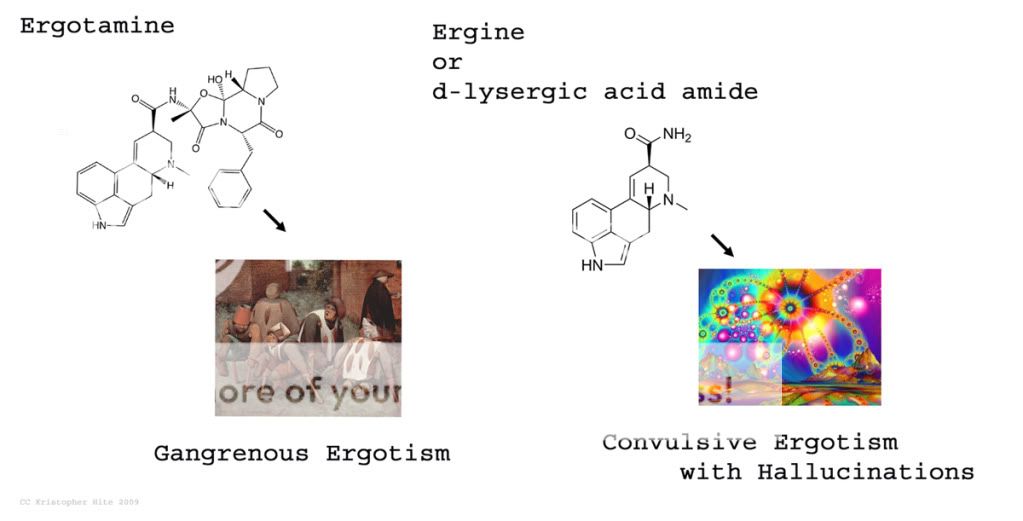
Mycotoxins contained in ergot infested rye caused two distinct varieties of ergotism. These toxins are known as the ergot alkaloids, and the two classes each have separate physiological effects - gangrenous or convulsive ergotism. Ergotamine, a powerful vasoconstrictor that prevents blood flow to the extremities, is the main culprit in gangrenous ergotism. Whereas ergine and lysergic acid hydroxyethylamide cause convulsive ergotism. These lysergic acid compounds have 10% the activity of the infamous psychoactive drug -LSD. Both LSD and the ergot alkaloids induce hallucinations by a similar and yet poorly understood mechanism. These compounds bind serotonin receptors in the brain as they are similar in shape and size to seratonin. It is not known how this induces hallucinations, but it is thought that agonist activity to serotonin releases higher concentrations of the neurotransmitter glutamate in the brain's cortex, exciting neurons in random ways. This would explain the varied psychological effects reported by individuals under the influence of this class of drugs.
By their activity, these compounds were known long before their chemical makeup was uncovered. Ergotamine had been used for nearly two centuries in midwifery to stop hemorrhaging after birth and also to induce abortion. In the first half of the 20th century the other ergot alkaloids were probed for other uses such as blood pressure and migraine treatments. A young chemist named Albert Hofmann, working for Sandoz pharmaceutical company in Basel, Switzerland, literally stumbled across LSD while performing organic synthesis of ergot alkaloids. His wild bicycle ride is a story of scientific lore worthy of its own post.
But here we are focused on the science behind medieval bewitching. The connection between ergotism and witch trials was first proposed by Linda Caporael in 1976 where she hypothesized in the Journal Science that Ergot could have been the real-world cause of the supposedly supernatural events that transpired in the village of Salem, Massachusetts in 1692.
In her paper, Caporael outlines the evidence for convulsive ergotism being the scourge that set off the string of hangings accompanying the infamous witch trials. Mainly, she points out that the symptoms of ergotism -spasms, the sensation of ants crawling under skin, and the feeling of being disemboweled - were all recorded by the court clerk when taking the testimony of the affected teenage accusers. Indeed, the very fact that the accusers were female and in their teens also implicates ergotism, as these are the most susceptible individuals in any community where there is an outbreak. Lastly, she turns to the geographic distribution of the bewitchment. Here she reconstructs a map of Salem village, where she hypothesizes that a contamination of grain grown on the eastern bank of the Wolleston river could have been the only source of ergot and still affected all the families involved.
Less than a year after her paper was published, skeptical scientists came in to refute her claims. Spanos and Gottlieb assert that Caporael is incorrect in her hypothesis and they give several reasons. They report that more townspeople should have shown signs of convulsive ergotism, that the afflicted girls did not testify to having exactly the same kind of symptoms expected from classic ergotism, and the town likely did not have a vitamin A deficiency that normally accompanies convulsive compared to gangrenous ergotism. Reading these rebuttals, there is no hard evidence in either direction which explains why this Science paper has not been retracted.
Despite this disagreement, Caporael's work inspired Mary Matossian to conduct further investigations into the possible connection between witch trials and ergotism outbreaks throughout the Middle Ages up until the 19th century. In her book Poisons of the Past Matossian lays out an incredibly convincing argument that outbreaks of ergotism indeed correlate to increased incidence of witch trials. She explains how tree ring data taken by x-ray measurements of tree ring density compiled for every year from 1269 - 1977 C.E. can be compared to an annual index of number of witch trials with statistical correlation in southwestern Germany and the Swiss alps.
Years where the growing season was cool and wet correspond to thicker tree rings and therefore seasons in which the amount of fungus growing amongst the rye was high. These long wet seasons directly preceded autumns with more witch trials. Like the medieval trials the Salem affair was also preceded by two years of unusually cold spring weather. Though there is evidence for a connection between ergot and witch trials in both Salem and the multitude of trials that took place in Europe throughout the Middle Ages, the evidence is stronger for the latter. In 2000 Alan Wolf, writing from the Harvard Medical School, further put the cabash on the Salem ergotism hypothesis. But if Carporeal had never posed the question, the work of Matossian may never have been conducted.
Further evidence for medieval outbreaks of both gangrenous and convulsive ergotism in Europe during the 16th century can be taken from a contemporary reporter. Transcending language and centuries the oil paintings of Pieter Bruegel the Elder give us an unusually clear window into recent human history. In the ergot alkaloid figure above a painting titled "the beggars" depicts peasants in what is now Belgium in the mid-1500s begging for food with stubs for limbs. Considering the geography and timing of these depictions, it is not difficult to imagine that these poor souls are suffering from gangrenous ergotism. Following his brush further we see in the 1562 painting below the story of Dull Gret or "Mad Meg" as she is known in English. Leading a band of paranoid peasant women, she storms the gates of hell, armed with cooking utensils, fearful that Spanish soldiers will pillage her village. "Mad Meg" of Flemish folklore may be under the influence of lysergic acid compounds found in Ergot!

When the imagery of Bruegel is conjured into mind, one can't help but wonder if generations of creative medieval minds weren't unwittingly dosed with background levels of the psychoactive components of Ergot.
As Samhain approaches, it is good to contemplate the possibility that some of the most infamous characters of all Hallows Eve may indeed have had very real biochemical origins.
I would like to thank Nick Clark for our many discussions and collaboration on this topic, and George Hudler for his kind advice and additional references and PowerPoint slides.
HUDLER, GEORGE W. Magical Mushrooms, Mischievous Molds. Princeton University Press, 1998. JSTOR, https://doi.org/10.2307/j.ctvs32r8v. Accessed 30 Oct. 2025.
Matossian, Mary Allerton Kilbourne. Poisons of the Past: Molds, Epidemics, and History. United Kingdom, Yale University Press, 1989.
Caporael, L. (1976). Ergotism: the satan loosed in Salem? Science, 192 (4234), 21-26 DOI: 10.1126/science.769159
Schweingruber, Fritz H., BrÄker, Otto U. & SchÄr, Ernst (1979). Dendroclimatic studies on conifers from central Europe and Great Britain Boreas, 8, 427-452
Schweingruber, Fritz H., BrÄker, Otto U. & SchÄr, Ernst (1979). Dendroclimatic studies on conifers from central Europe and Great Britain Boreas, 8, 427-452
Subscribe to:
Posts (Atom)