To do this video justice please crank the resolution up as high as your computer will allow. I think it tops out at 720p. Change it by clicking the gear-like shape at the bottom right of the you-tube window.
Showing posts with label conscious evolution. Show all posts
Showing posts with label conscious evolution. Show all posts
Wednesday, March 28, 2012


Sunday, February 20, 2011
Evolution of a line
"A Sequence of Lines Consecutively Traced by Five Hundred Individuals is an online drawing tool that lets users do just one thing - trace a line. Each new user only sees the latest line drawn, and can therefore only trace this latest imperfect copy. As the line is reproduced over and over, it changes and evolves - kinks, trembling motions and errors are exaggerated through the process. A Sequence of Lines Consecutively Traced by Five Hundred Individuals was first created as a tool to be used in conjunction with Amazon’s Mechanical Turk - an online labor market. Mechanical Turk workers were paid 2 cents to trace a line."
Monday, January 31, 2011
EGYPT
"Now, ultimately the future of Egypt will be determined by the Egyptian people. And I believe that the Egyptian people want the same things that we all want -- a better life for ourselves and our children, and a government that is fair and just and responsive. Put simply, the Egyptian people want a future that befits the heirs to a great and ancient civilization."
~ President Barack Obama
~ President Barack Obama
Sunday, November 14, 2010
Wednesday, November 10, 2010
Friday, November 5, 2010
ABOUND SOLAR
I have written about this company 6 times over the last 3 years and each time I've thought they were near an IPO. Today I heard the first hint of news indicating the possibility for this fledgling solar cell company from Fort Collins, Colorado. The CEO of Abound Solar - Tom Tiller - was quoted in this article indicating an IPO as something that might happen in the near future. Perhaps I need to do a little source checking here as he is either misquoted or really does sound like a business-robot.
He said...
"We hit the knowledge to acquire this consort and create continuance in this process. If things go substantially and business markets are cooperative, as we intend toward the latter conception of incoming year, we strength study an IPO"
If I can translate to English, I think he is saying that the technology they have developed has finally proven cost effective enough to warrant further expansion and possibly a public offering of stock. I'm not sure what language he is speaking in the last sentence but it seems positive.
The take home message? Keep your eye out for this company going public soon. Why?
Look at their biggest rival First Solar. This is what it did within the first year after going public.
$25 to over $300 a share in just over a year.

He said...
"We hit the knowledge to acquire this consort and create continuance in this process. If things go substantially and business markets are cooperative, as we intend toward the latter conception of incoming year, we strength study an IPO"
If I can translate to English, I think he is saying that the technology they have developed has finally proven cost effective enough to warrant further expansion and possibly a public offering of stock. I'm not sure what language he is speaking in the last sentence but it seems positive.
The take home message? Keep your eye out for this company going public soon. Why?
Look at their biggest rival First Solar. This is what it did within the first year after going public.
$25 to over $300 a share in just over a year.

Thursday, November 4, 2010
Wednesday, October 13, 2010
BARP Goes the Weasel!
By Kristopher Hite

 This post has been submitted to the NESCent competition for a travel award for the ScienceOnline 2011 un-conference January 13-15 in North Carolina’s Research Triangle Park.
Wu, D., Hugenholtz, P., Mavromatis, K., Pukall, R., Dalin, E., Ivanova, N., Kunin, V., Goodwin, L., Wu, M., Tindall, B., Hooper, S., Pati, A., Lykidis, A., Spring, S., Anderson, I., D’haeseleer, P., Zemla, A., Singer, M., Lapidus, A., Nolan, M., Copeland, A., Han, C., Chen, F., Cheng, J., Lucas, S., Kerfeld, C., Lang, E., Gronow, S., Chain, P., Bruce, D., Rubin, E., Kyrpides, N., Klenk, H., & Eisen, J. (2009). A phylogeny-driven genomic encyclopaedia of Bacteria and Archaea Nature, 462 (7276), 1056-1060 DOI: 10.1038/nature08656
Looking back at discoveries of the past year the one that sticks out above all others to me was the identification of a single protein; a bacterial actin homologue dubbed BARP - Bacterial Actin Related Protein. The brilliance of this discovery comes from its directly contributing to our understanding of evolution, overturning decades of dogma, and providing a shiny new teaching tool. The discovery was published in late 2009 as part of a massive sequencing project to fill in gaps of knowledge among bacterial and archael genomes.
With all the other sexy and more controversial stories about evolution - Ardi, Ida and so on, why do I pick this one? Aside from my biochemical inclination I thought this little piece of biological hardware deserved more exposure. Though the paper was covered and lead author Jonathan Eisen interviewed for the nature podcast, it received relatively little coverage on the science blogs. Yes, the prolific science writer Carl Zimmer wrote a nice summary for the New York Times but the BARP bit is mentioned only briefly. I don't know if anyone realized what a great tool this discovery is to hammer even more nails in the coffin of the "irreducible complexity" argument for intelligent design.
With all the other sexy and more controversial stories about evolution - Ardi, Ida and so on, why do I pick this one? Aside from my biochemical inclination I thought this little piece of biological hardware deserved more exposure. Though the paper was covered and lead author Jonathan Eisen interviewed for the nature podcast, it received relatively little coverage on the science blogs. Yes, the prolific science writer Carl Zimmer wrote a nice summary for the New York Times but the BARP bit is mentioned only briefly. I don't know if anyone realized what a great tool this discovery is to hammer even more nails in the coffin of the "irreducible complexity" argument for intelligent design.
In January 2010 I had the pleasure to sit down and interview Eugenie Scott - executive director of the National Center for Science Education (NSCE). As she explained the history of science education in the United States we came to an agreement on what one "take home" message should be for the average high school student - that all living things on earth share common ancestors, that all species have a common descent. This point may not seem earth-shattering to comprehend but I think many in America fail to realize the significance of this fact. The procession of science has uncovered an armory of teaching tools - fossilized trilobites, floating whale hip bones, and common DNA sequences. The more is known about the inner workings of the natural world the easier it should be for students to see and accept the facts. What then is the barrier to getting students to accept take-home messages like common descent? I would posit that fundamentalist opposition to evolution and the idea of the rapture have more than a little to do with it. Proponents of intelligent design often use a phrase coined by Lehigh University professor Michael Behe - irreducible complexity - in their defense of a necessary designer. This was a large part of Behe's arguments against teaching evolution as fact in the Kitzmiller vs. Dover, PA landmark court case.
Behe defines an irreducibly complex system as one "composed of several well-matched, interacting parts that contribute to the basic function, wherein the removal of any one of the parts causes the system to effectively cease functioning." Brown University Biology Professor Ken Miller uses the analogy of a mouse trap to explain away irreducible complexity. Yes, all components of a mouse trap are necessary for overall function but each component can be have alternate uses.
In the logical chronology of evolution complexity emerges incrementally by the acquisition of functional structures that appear by chance and remain due to conferred advantage. Behe has tried over and over to use the molecular structure of the bacterial flagellum as an example of an irreducibly complex system. In response Ken Miller did an excellent job explaining how the components of bacterial flagella could emerge incrementally.
So what IS actin and how does its showing up in a bacterial specimen add to the arsenal of teaching tools against irreducible complexity?
 |
| actin filament |
As you move your cursor around this page your muscles are contracting and relaxing, your brain is sending signals along tiny electrified
strands called axons guiding these contractions. Among the myriad
things that make this possible is the little protein called actin.
Deriving its name from the word "activating" actin enables muscular
motion, provides train tracks inside each cell for directional transportation of other tools, and gives shape to most cells in your body. Like oddly
shaped legos these tiny building blocks bind to each other and form long
filaments that grow and shrink. A mesh-work of actin filaments push on
the perimeter of each cell establishing shape. Those long axons I
mentioned before are extensions of brain cells (neurons). During
development neurons send out these long extensions and it is the mesh-work of actin that leads the charge enabling all those millions of
electronic connections between brain and body to form.
The
gene that codes for this little protein exists without much variation
in all eukaryotic organisms. Eukaryote means simply "true nucleus." The distinction is made because the more
ancient but still surviving bacteria do not have "true nuclei" they
are therefore dubbed prokaryotes. The moment at which the first
eukaryote appeared on earth marked the beginning of an explosion of diversity, and a
fundamental branch point in the phylogenetic tree of life.
 |
| (Haliangium ochraceum) |
Unlike the carefully crafted nuts and bolts you can pick up at the hardware store cellular machinery is not designed for a purpose, it just appears by duplication, mutation, or other spontaneous variations of genetic material. If it works it is retained, if its merely eating up metabolic resources it usually goes extinct. This represents an important variation on pure chance that the process of evolution carries with it. Richard Dawkins has illustrated the power of evolving systems to accumulate positive variation in his classic "Weseal" thought experiment. Self-replicating systems have the ability to retain random variation in their code by copying themselves. When a variation carries a positive effect for the code carrier (organism) then that carrier is more likely to make more copies of that advantageous variation. New variation is possible because there are usually redundant bits of cellular machinery. This is exactly what we see in the case of BARP.
If you asked any professor of cell biology any time prior to a year ago "Do bacteria contain a gene for actin?" they would, without hesitation, say "of course not." It was understood that the gene for actin was one that separated eukaryote from prokaryote. Bacteria have an unrelated gene - MreB - that has a scaffolding function. They don't need actin. Now it is shown that the gene for actin may have shown up in marine bacteria (specifically the one named Haliangium ochraceum) prior to the evolutionary branch-point. If this is the case it means that actin was later recruited to its now prolific function giving shape and motion to eukaryote cells. Actin was not designed then implemented like machined parts in human created contraptions. According to this research it probably appeared by chance in marine bacteria, served some other unknown function, then just happened to work later on in evolution. This, I think, is why many mechanical engineers have an aversion to studying the slimy, oozing, organic structures in nature. They are inherently messy and imperfect. This is because they are not designed! They are the result of chance events captured inside self-replicating systems - us included.
If you asked any professor of cell biology any time prior to a year ago "Do bacteria contain a gene for actin?" they would, without hesitation, say "of course not." It was understood that the gene for actin was one that separated eukaryote from prokaryote. Bacteria have an unrelated gene - MreB - that has a scaffolding function. They don't need actin. Now it is shown that the gene for actin may have shown up in marine bacteria (specifically the one named Haliangium ochraceum) prior to the evolutionary branch-point. If this is the case it means that actin was later recruited to its now prolific function giving shape and motion to eukaryote cells. Actin was not designed then implemented like machined parts in human created contraptions. According to this research it probably appeared by chance in marine bacteria, served some other unknown function, then just happened to work later on in evolution. This, I think, is why many mechanical engineers have an aversion to studying the slimy, oozing, organic structures in nature. They are inherently messy and imperfect. This is because they are not designed! They are the result of chance events captured inside self-replicating systems - us included.
This post has been submitted to the NESCent competition for a travel award for the ScienceOnline 2011 un-conference January 13-15 in North Carolina’s Research Triangle Park.Wu, D., Hugenholtz, P., Mavromatis, K., Pukall, R., Dalin, E., Ivanova, N., Kunin, V., Goodwin, L., Wu, M., Tindall, B., Hooper, S., Pati, A., Lykidis, A., Spring, S., Anderson, I., D’haeseleer, P., Zemla, A., Singer, M., Lapidus, A., Nolan, M., Copeland, A., Han, C., Chen, F., Cheng, J., Lucas, S., Kerfeld, C., Lang, E., Gronow, S., Chain, P., Bruce, D., Rubin, E., Kyrpides, N., Klenk, H., & Eisen, J. (2009). A phylogeny-driven genomic encyclopaedia of Bacteria and Archaea Nature, 462 (7276), 1056-1060 DOI: 10.1038/nature08656
Monday, January 25, 2010
Eugenie Scott Interview
If you notice in the first 10 minutes I shut the door due to the vacuum cleaner at the bookstore and begin recording on my phone. What follows is the remaining hour and 10 minutes of the interview if you are interested in hearing more. I actually get to answer some TPG reader questions in the later part of the interview. I'm amazed at the sound quality from a recording to an iphone.


Thursday, November 5, 2009
Saturday, October 31, 2009
The Biochemistry of Halloween: Installment II
 |
| The moon through the cottonwood trees on the Oval at Colorado State University Photo credit - Kristopher Hite |
By Kristopher Hite updated and edited - 10/30/2025
Mothers and fathers watched the shriveled toes of a poor beggar swing from the gallows. They placed their faith in God that the death of this unfortunate person might take away the torment, fits, and visions that plagued their children. That somehow, through supernatural forces, the sensations of ants crawling underneath skin, delusions of bursting into flames, and frenzied shrieks of terror in the night would cease. As the seasons brought new harvest,s the number of swinging bodies dwindled. But bouts of bewitchment would visit the same locales for centuries.
This was a typical scene in the medieval villages that lined the dank Rhône and Rhine River valleys following the seam of modern-day Germany and France south through Switzerland to the Italian border. Here and in other curiously coincidental microclimates all over Europe, something dark and treacherous lurked in the fields.
 |
| A sclerotium of Claviceps purpurea on a wheat frond. Photo credit - Dominique Jacquin |
During the cold, wet growing seasons, a deep maroon-colored fungus Claviceps purpurea reared its ugly sclerotium amongst the ears of rye. Looking much like the rooster's spur, the killer was given the French name - erogot. When rye was milled, the flour could contain up to 30% ergot by dry weight. And so it goes that the biochemistry of bewitchment had its origins under the millstones of fifteenth-century Europe.
During this age, the peasantry ate an enormous proportion of the darker, cheaper rye bread; upwards of three pounds a day. As the alkaloids made by the ergot found their way into the blood and brains of those apparently seized by demons, the unaffected were left to assume they had been bewitched. The linguistic fossil preserved in the very word - seizure - describes the uncontrolled fits that the affected person displayed. A condition known at the time as "St Anthony's fire" (aka Ignis Sacer) did not become known as ergotism until 1853 when the clinical connection to the mycotoxins was finally made.
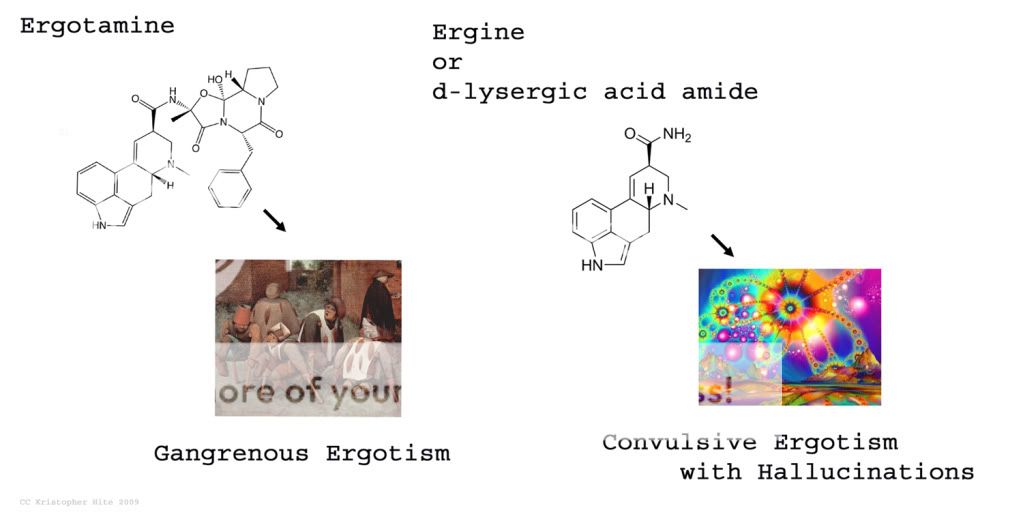
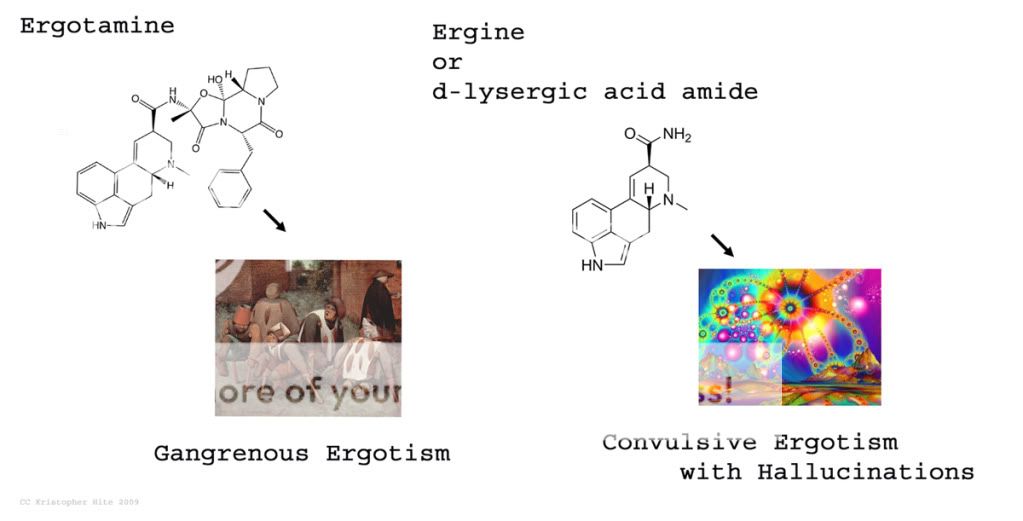
Mycotoxins contained in ergot infested rye caused two distinct varieties of ergotism. These toxins are known as the ergot alkaloids, and the two classes each have separate physiological effects - gangrenous or convulsive ergotism. Ergotamine, a powerful vasoconstrictor that prevents blood flow to the extremities, is the main culprit in gangrenous ergotism. Whereas ergine and lysergic acid hydroxyethylamide cause convulsive ergotism. These lysergic acid compounds have 10% the activity of the infamous psychoactive drug -LSD. Both LSD and the ergot alkaloids induce hallucinations by a similar and yet poorly understood mechanism. These compounds bind serotonin receptors in the brain as they are similar in shape and size to seratonin. It is not known how this induces hallucinations, but it is thought that agonist activity to serotonin releases higher concentrations of the neurotransmitter glutamate in the brain's cortex, exciting neurons in random ways. This would explain the varied psychological effects reported by individuals under the influence of this class of drugs.
By their activity, these compounds were known long before their chemical makeup was uncovered. Ergotamine had been used for nearly two centuries in midwifery to stop hemorrhaging after birth and also to induce abortion. In the first half of the 20th century the other ergot alkaloids were probed for other uses such as blood pressure and migraine treatments. A young chemist named Albert Hofmann, working for Sandoz pharmaceutical company in Basel, Switzerland, literally stumbled across LSD while performing organic synthesis of ergot alkaloids. His wild bicycle ride is a story of scientific lore worthy of its own post.
But here we are focused on the science behind medieval bewitching. The connection between ergotism and witch trials was first proposed by Linda Caporael in 1976 where she hypothesized in the Journal Science that Ergot could have been the real-world cause of the supposedly supernatural events that transpired in the village of Salem, Massachusetts in 1692.
In her paper, Caporael outlines the evidence for convulsive ergotism being the scourge that set off the string of hangings accompanying the infamous witch trials. Mainly, she points out that the symptoms of ergotism -spasms, the sensation of ants crawling under skin, and the feeling of being disemboweled - were all recorded by the court clerk when taking the testimony of the affected teenage accusers. Indeed, the very fact that the accusers were female and in their teens also implicates ergotism, as these are the most susceptible individuals in any community where there is an outbreak. Lastly, she turns to the geographic distribution of the bewitchment. Here she reconstructs a map of Salem village, where she hypothesizes that a contamination of grain grown on the eastern bank of the Wolleston river could have been the only source of ergot and still affected all the families involved.
Less than a year after her paper was published, skeptical scientists came in to refute her claims. Spanos and Gottlieb assert that Caporael is incorrect in her hypothesis and they give several reasons. They report that more townspeople should have shown signs of convulsive ergotism, that the afflicted girls did not testify to having exactly the same kind of symptoms expected from classic ergotism, and the town likely did not have a vitamin A deficiency that normally accompanies convulsive compared to gangrenous ergotism. Reading these rebuttals, there is no hard evidence in either direction which explains why this Science paper has not been retracted.
Despite this disagreement, Caporael's work inspired Mary Matossian to conduct further investigations into the possible connection between witch trials and ergotism outbreaks throughout the Middle Ages up until the 19th century. In her book Poisons of the Past Matossian lays out an incredibly convincing argument that outbreaks of ergotism indeed correlate to increased incidence of witch trials. She explains how tree ring data taken by x-ray measurements of tree ring density compiled for every year from 1269 - 1977 C.E. can be compared to an annual index of number of witch trials with statistical correlation in southwestern Germany and the Swiss alps.
Years where the growing season was cool and wet correspond to thicker tree rings and therefore seasons in which the amount of fungus growing amongst the rye was high. These long wet seasons directly preceded autumns with more witch trials. Like the medieval trials the Salem affair was also preceded by two years of unusually cold spring weather. Though there is evidence for a connection between ergot and witch trials in both Salem and the multitude of trials that took place in Europe throughout the Middle Ages, the evidence is stronger for the latter. In 2000 Alan Wolf, writing from the Harvard Medical School, further put the cabash on the Salem ergotism hypothesis. But if Carporeal had never posed the question, the work of Matossian may never have been conducted.
Further evidence for medieval outbreaks of both gangrenous and convulsive ergotism in Europe during the 16th century can be taken from a contemporary reporter. Transcending language and centuries the oil paintings of Pieter Bruegel the Elder give us an unusually clear window into recent human history. In the ergot alkaloid figure above a painting titled "the beggars" depicts peasants in what is now Belgium in the mid-1500s begging for food with stubs for limbs. Considering the geography and timing of these depictions, it is not difficult to imagine that these poor souls are suffering from gangrenous ergotism. Following his brush further we see in the 1562 painting below the story of Dull Gret or "Mad Meg" as she is known in English. Leading a band of paranoid peasant women, she storms the gates of hell, armed with cooking utensils, fearful that Spanish soldiers will pillage her village. "Mad Meg" of Flemish folklore may be under the influence of lysergic acid compounds found in Ergot!

When the imagery of Bruegel is conjured into mind, one can't help but wonder if generations of creative medieval minds weren't unwittingly dosed with background levels of the psychoactive components of Ergot.
As Samhain approaches, it is good to contemplate the possibility that some of the most infamous characters of all Hallows Eve may indeed have had very real biochemical origins.
I would like to thank Nick Clark for our many discussions and collaboration on this topic, and George Hudler for his kind advice and additional references and PowerPoint slides.
HUDLER, GEORGE W. Magical Mushrooms, Mischievous Molds. Princeton University Press, 1998. JSTOR, https://doi.org/10.2307/j.ctvs32r8v. Accessed 30 Oct. 2025.
Matossian, Mary Allerton Kilbourne. Poisons of the Past: Molds, Epidemics, and History. United Kingdom, Yale University Press, 1989.
Caporael, L. (1976). Ergotism: the satan loosed in Salem? Science, 192 (4234), 21-26 DOI: 10.1126/science.769159
Schweingruber, Fritz H., BrÄker, Otto U. & SchÄr, Ernst (1979). Dendroclimatic studies on conifers from central Europe and Great Britain Boreas, 8, 427-452
Schweingruber, Fritz H., BrÄker, Otto U. & SchÄr, Ernst (1979). Dendroclimatic studies on conifers from central Europe and Great Britain Boreas, 8, 427-452
Monday, September 28, 2009
The "Theorum" of Evolution
By Kristopher Hite
Within the first pages of Richard Dawkins' newest book - The Greatest Show on Earth; the evidence for evolution the author continues on his life-long spree of neologisms by coining a new term for expressing the concept of evolution. Dawkins proposes a change from calling it the "theory of evolution" to the "theorum of evolution." This is not to be confused with a mathematical THEOREM spelled with an e but is chosen to give a more specific slant and weight to a particular meaning of the word "theory" in the context of evolution. This particular meaning being a systematic set of ideas that account for a body of facts. Dawkins is trying to provide the lexicon with a word that differentiates the meaning provided in the last sentence from the secondary definition of the word "theory" which is a "speculative conjecture, or idea" giving the impression that, used in this sense, an idea is merely a concept or "only a theory." This second definition is often used by intelligent design proponents to basically give the false impression that the concept of evolution has not been proven.
Well it has, and the most stark evidence for descent with modification driven by natural selection that chemical biology can currently provide lies in the genetic code. Comparing sequences of DNA we are able to see that certain sequences match and others partially match in mammoths and mice, frogs and dogs, and in some genes even humans and plants. We can see in the code what is known as molecular phylogeny. We see in matching strings of As Ts Gs and Cs that every organism is living at the tip of a theoretical branch in an ancient tree of life with a central trunk from which we all descended through countless generations of successfully prolific ancestors. To give an example, the genes that dictate the human body plan (Hox genes) are also present in all major branches in the "animal" part of the tree. It has been shown by comparative molecular phylogenetic analysis that these genes arose before the Cambrian explosion about 530 million years before any kind of hominid creature roamed the earth.
Great, but why should we care? Why should anyone not making their living in a biologically inclined academic setting need to understand the "theorum" of evolution?
Humans are uniquely positioned in the animal kingdom to predict and outmaneuver the inherent screening process that normally facilitates natural selection among all other organisms. On a single person scale, I myself would not be alive today were it not for the maneuvering of medical technology. When I was born I inhaled part of the afterbirth and had to have my lungs pumped right away. On a global scale, the natural selection screen of limited fossil fuels is rapidly approaching and regardless of your thoughts on the evidence for global climate change, survival in the face of resource depletion requires that we understand how evolution by natural selection works if we hope to overcome and outsmart the brutality of resource wars.
In the above movie when I talk of a "peaceful survival strategy" being the most successful. I should qualify that further by saying a cooperative and empathetic strategy will out-compete a selfish and aggressive strategy. This is demonstrated by the algorithms of Robert Axelrod explained in great detail in the later chapters the Selfish Gene while the parameters of those strategies are further explored in this paper.
Serendipitously, in a review (which I had not read until after composing this post) of the new book The Age of Empathy by Frans De Waal some of the concepts that I just mentioned are fleshed out even more. The review was aptly titled Survival of the Kindest and apperaerd in SEED magazine last week. Check it out for yourself.
This post has been submitted to the NESCent competition for a travel award for the ScienceOnline 2010 un-conference in Durham, NC, January 14‐17th, 2010.
To the Judges. I realize that this post is less than the 750 word minimum set as a standard by the competition, but I would argue that because of the video the post actually far exceeds 750 words. there is no specification in the rules that the 750 words had to be all in written format.
Axelrod, R., & Dion, D. (1988). The Further Evolution of Cooperation Science, 242 (4884), 1385-1390 DOI: 10.1126/science.242.4884.1385
Gehring WJ, Kloter U, & Suga H (2009). Evolution of the Hox gene complex from an evolutionary ground state. Current topics in developmental biology, 88, 35-61 PMID: 19651301
Within the first pages of Richard Dawkins' newest book - The Greatest Show on Earth; the evidence for evolution the author continues on his life-long spree of neologisms by coining a new term for expressing the concept of evolution. Dawkins proposes a change from calling it the "theory of evolution" to the "theorum of evolution." This is not to be confused with a mathematical THEOREM spelled with an e but is chosen to give a more specific slant and weight to a particular meaning of the word "theory" in the context of evolution. This particular meaning being a systematic set of ideas that account for a body of facts. Dawkins is trying to provide the lexicon with a word that differentiates the meaning provided in the last sentence from the secondary definition of the word "theory" which is a "speculative conjecture, or idea" giving the impression that, used in this sense, an idea is merely a concept or "only a theory." This second definition is often used by intelligent design proponents to basically give the false impression that the concept of evolution has not been proven.Well it has, and the most stark evidence for descent with modification driven by natural selection that chemical biology can currently provide lies in the genetic code. Comparing sequences of DNA we are able to see that certain sequences match and others partially match in mammoths and mice, frogs and dogs, and in some genes even humans and plants. We can see in the code what is known as molecular phylogeny. We see in matching strings of As Ts Gs and Cs that every organism is living at the tip of a theoretical branch in an ancient tree of life with a central trunk from which we all descended through countless generations of successfully prolific ancestors. To give an example, the genes that dictate the human body plan (Hox genes) are also present in all major branches in the "animal" part of the tree. It has been shown by comparative molecular phylogenetic analysis that these genes arose before the Cambrian explosion about 530 million years before any kind of hominid creature roamed the earth.
Great, but why should we care? Why should anyone not making their living in a biologically inclined academic setting need to understand the "theorum" of evolution?
Humans are uniquely positioned in the animal kingdom to predict and outmaneuver the inherent screening process that normally facilitates natural selection among all other organisms. On a single person scale, I myself would not be alive today were it not for the maneuvering of medical technology. When I was born I inhaled part of the afterbirth and had to have my lungs pumped right away. On a global scale, the natural selection screen of limited fossil fuels is rapidly approaching and regardless of your thoughts on the evidence for global climate change, survival in the face of resource depletion requires that we understand how evolution by natural selection works if we hope to overcome and outsmart the brutality of resource wars.
In the above movie when I talk of a "peaceful survival strategy" being the most successful. I should qualify that further by saying a cooperative and empathetic strategy will out-compete a selfish and aggressive strategy. This is demonstrated by the algorithms of Robert Axelrod explained in great detail in the later chapters the Selfish Gene while the parameters of those strategies are further explored in this paper.
Serendipitously, in a review (which I had not read until after composing this post) of the new book The Age of Empathy by Frans De Waal some of the concepts that I just mentioned are fleshed out even more. The review was aptly titled Survival of the Kindest and apperaerd in SEED magazine last week. Check it out for yourself.
To the Judges. I realize that this post is less than the 750 word minimum set as a standard by the competition, but I would argue that because of the video the post actually far exceeds 750 words. there is no specification in the rules that the 750 words had to be all in written format.
Axelrod, R., & Dion, D. (1988). The Further Evolution of Cooperation Science, 242 (4884), 1385-1390 DOI: 10.1126/science.242.4884.1385
Sunday, March 15, 2009
ABOUND SOLAR
"Abundance Emerges"
The company formerly known as AVA Solar has unveiled a new name - ABOUND SOLAR.
The vision of W.S. Sampath, Abound Solar is based in Fort Collins, Colorado and is embarking on large scale production of low-cost thin-film solar panels. Dr. Sampath is as much a hero as anyone could hope to find in this world. The idea of harnessing the abundant radiant energy that bathes our planet is not a new invention; in fact within the evolution of Earth’s biosphere it is a most ancient innovation. Human-made solar panels have been around long enough that the truly awesome globe-changing promise they offer has almost been forgotten. Perhaps the most precipitous obstacle for the coming of age for solar energy has been affordability.  For over 15 years, Sampath has nurtured a vision to develop technology enabling low-cost production of thin-film solar cells. By reducing production costs, sun-derived energy will be significantly more affordable. In essence, he has fulfilled that dream and will produce solar energy at approximately $1 per Watt bringing the cost down from $13 a Watt achieved by traditional silicon solar cell systems.
The story of this company is a literal ray of sunshine in the midst of the darkest economic times our generation has ever seen. The story of Abound Solar provides great hope accompanying the promise of renewal our president likes to speak of so frequently. The impact this will have on a global scale sends shivers through my fingers. When a child can educate him/herself anywhere in the world by illuminating a book with energy from the sun, even as darkness falls democracy and free thought will prevail. As Thomas Jefferson said "where the press is free, and every man able to read, all is safe." A world full of illuminated minds is a safe world. Barriers to affordable energy keep stone aged philosophies alive on our globe today and as Nikola Tesla foretold, only equal access will remedy that.
Freeing ourselves from the current addiction to fossil fuel represents perhaps the greatest challenge in our world today. Will Abound Solar be the company to rise to the challenge and bring solar energy capabilities to the masses? Time and the market will answer this question. But, Abound Solar certainly has the hope and support of Tom Paine's Ghost.
It has been an inspiration to witness a man with such noble intentions turn a dream into reality on such a scale. As Thomas Paine might say - May the merit of our ideas rather than the weight of history pull us from the brink on which we find ourselves.
SOURCE: Solar Industry Magazine, PV-tech.org
Stay tuned to TPG for further updates through Google, Yahoo, or directly.
Saturday, March 14, 2009
Gaia Cleansing
 The idea that Earth's biosphere operates cooperatively as a singular superorganism (also known as Gaia theory) has gained footing as more than just a new age worldview since its formation by James Lovelock and Lynn Margulis in the late 1960's. With the publication of James Lovelock's book Gaia - a New Look at Life on Earth the idea that life would go on with or without humanity began trickling into general consciousness.
Forty years later Lovelock is not optimistic about the future of humanity in the face of inevitable global climate change. A year ago he was quoted in the Guardian as believing that "global warming is now irreversible, and that nothing can prevent large parts of the planet becoming too hot to inhabit, or sinking underwater, resulting in mass migration, famine and epidemics." He highly doubts the efficacy of green initiatives saying it is really all too little too late.
When we go to the grocery store on our bikes and fill up reusable grocery bags with organic veggies are we simply rearranging the deck chairs on the titanic? No one who has made these life changes wants to concede that. But at least we have new leadership that might steer us away from the iceberg. If the desire to make small lifestyle changes spreads to a large enough scale perhaps some environmental mitigation will manifest. In the meantime it might be worth investing in planning "cities of the future" so we might have rafts of survival when southwest Asia runs out of glacial melt water and the Mediterranean gets flooded by Greenland falling into the north Atlantic.
Maybe all the houses left empty by the financial meltdown can be left vacant and be readied for the billion plus climate refugees that might be displaced in the near future. In the face of inevitable catastrophe James Lovelock tells a reporter to "Enjoy life while you can. Because if you're lucky it's going to be 20 years before it hits the fan." Cheers to that! We all need to eat drink and be merry regardless of the negative drivel that oozes from the television screen.
What do you think about Lovelock's outlook?
Free Energy
For the sake of making the hidden abundance of energy on earth more widely known we present a part of the popular film Zeitgeist addendum.
Disclaimer. Admittedly the Zeitgeist films feel like left wing propaganda but there seem to be some valid points embedded within a cloud of preachyness.
Lighting a 60 Watt bulb for 1 hour uses 216,000 Joules. One zetaJoule is 1,000,000,000,000,000,000,000 Joules. this amount of energy could light one 60 Watt bulb for every human on earth continuously for 79 years.
Monday, February 23, 2009
Post with the Most on Tom Paine's Ghost

The above scene is one of ten panels that adorn the double doors to the octagonal building known as the baptistry in the center of Florence, Italy. In 1401 a competition was held among the sculptors of the day for the privilege of creating these doors. Doors Michelangelo would later dub the "gates of paradise." The use of point perspective and heightened human realism marked the end of the dark ages and the beginning of the Renaissance. As we emerge from eight years of darkness perhaps a competition in the context of New Media can facilitate the evolution of our communication.
Tom Paine's Ghost is excited to announce the first annual TPG Composition Competition.
A $100 cash prize will be awarded for the most aesthetically powerful multi-media blog post.
Post content is limited only by the bounds of imagination. Keep in mind Tom Paine's Ghost was founded amidst a battle to defend freedom of the press and we hope to echo that theme throughout our pages.
Submissions will be selected and judged on the basis of four criteria:
1. Clarity
2. Originality
3. Integration (at least three forms of media must be utilized, images, text, movies, audio, etc.)
4. Power (the post's ability to motivate readers to action).
Submissions will be accepted until April 2, 2009. Submit entries by email to Tom Paine's Ghost. Please submit HTML for your post within the body of the e-mail. If you would like to submit a link to your own blog please write a three to four sentence primer to be published on TPG along with your link. Selected submissions will be posted here at TPG and voted on by our panel of citizen judges. The winner will be announced on April 22, 2009 and will be notified by email. Whether this is your first post or your one thousandth all submissions will be reviewed.
Cheers to revolution via evolution!
Sunday, February 22, 2009
Jihad against junk food
I have been waiting for a hero in the US to stand and fight for more healthful food in schools. Whenever I engage in conversation on this topic the archetype of Jamie Oliver and his "feed me better" campaign in Brittan comes up. Read his manifesto where he outlines a strategy for putting fresh local ingredients into the cafeteria. Talk about people powered media, Mr. Oliver encourages children to use their cell phone cameras to take pictures of the their school lunches and post them on his site. Internal checks to ensure the reform is happening on the ground. This could happen in the US, but living in the breadbasket of the world we have some of the largest food production lobbies on the planet. Look what we are up against.
Saturday, January 17, 2009
The Pennsylvania Constitution of 1776
 On the birthday of Benjamin Franklin I think it appropriate to review a particularly progressive collaboration between he and Thomas Paine - the Pennsylvania Constitution of 1776. This document is considered by some historians to be the most "democratic" legislation to emerge from revolutionary America. This was the first legislation drafted that directly echoed the Declaration of Independence and further enunciated and protected the freedom of every person to "natural rights" including the right to worship "according to the dictates of their own conscience." Also, the language of this document presents a situation wherein all men, no matter race or creed were free to vote. This being penned in 1776 was a little too radical for the time. In 1790 it was amended by conservatives in that state to be more inline with the other state's constitutions.
From the preamble it is clear that this document serves as a universal template for an evolving government. It also highlights the balance of consciousness Ben Franklin and Thomas Paine had. Though they did not agree on the extent to which to renounce religion themselves they did understand the significance of embedding religious freedom in the legal genome of posterity's government.
"We, the representatives of the freemen of Pennsylvania, in general convention met, for the express purpose of framing such a government, confessing the goodness of the great Governor of the universe (who alone knows to what degree of earthly happiness mankind may attain, by perfecting the arts of government) in permitting the people of this State, by common consent, and without violence, deliberately to form for themselves such just rules as they shall think best, for governing their future society; and being fully convinced, that it is our indispensable duty to establish such original principles of government, as will best promote the general happiness of the people of this State, and their posterity, and provide for future improvements, without partiality for, or prejudice against any particular class, sect, or denomination of men whatever, do, by virtue of the authority vested in us by our constituents, ordain, declare, and establish, the following Declaration of Rights and Frame of Government, to be the CONSTITUTION of this commonwealth, and to remain in force therein for ever, unaltered, except in such articles as shall hereafter on experience be found to require improvement, and which shall by the same authority of the people, fairly delegated as this frame of government directs, be amended or improved for the more effectual obtaining and securing the great end and design of all government"
Read the rest here.
Thursday, October 16, 2008
Voting by Mail Changes the Game in Colorado
Every fall in Fort Collins, CO the city holds the "New West Fest," a celebration of local music, art, and business. Here we see the "new west" emerge as a crucial factor in the 2008 presidential election. While many rural areas in the east (like my hometown - Boomertown, NY) have experienced a brain-drain for decades, places like Fort Collins, CO are on the receiving end of that flowing gray matter. I am pleased to see that this demographic, the 20 something college educated "New Wester," is being realized as a genuine political tour de-force.
Folks born between 1978-2000 have been dubbed "millennials" and we number around 95 million. Compare this to the roughly 73 million "baby-boomers" that have held sway over American politics since the mid 1960's. Our political weight is finally being felt. Whether our youth or our apathy held us back in 2004, it does not matter, we have now in 2008 united behind certain shared values that have grown up with us, and it is apparent in this election. We are the generation that grew up watching "Captain Planet" on Saturday mornings, and remember movies like Fern Gully and Land Before Time. The ghost of Jim Henson still whispers the moral of the story in our ears at night. We like thinking and planning green.
Millennials have also been called "Generation We" for our unprecedented cooperativity enabled by the internet. The world has grown a nervous system and we are the neurons. Our blog posts, our Facebook pokes, our text messages, our i-reports are the electro-chemical bursts giving life to a new global organism. The financial firestorm is manifestation of the mental breakdown of this organism while it reconciles the differences so exaggerated during the last eight years. The Markos Moulitsas' and the Bill O'Reilly's of the world have stretched the rubber-band of the polis so far to either side that it is crashing back to center and we are having to redefine and reassign value. May the millennials deliver on their promises and bring conscious evolution to the halls of Washington.

Folks born between 1978-2000 have been dubbed "millennials" and we number around 95 million. Compare this to the roughly 73 million "baby-boomers" that have held sway over American politics since the mid 1960's. Our political weight is finally being felt. Whether our youth or our apathy held us back in 2004, it does not matter, we have now in 2008 united behind certain shared values that have grown up with us, and it is apparent in this election. We are the generation that grew up watching "Captain Planet" on Saturday mornings, and remember movies like Fern Gully and Land Before Time. The ghost of Jim Henson still whispers the moral of the story in our ears at night. We like thinking and planning green.
Millennials have also been called "Generation We" for our unprecedented cooperativity enabled by the internet. The world has grown a nervous system and we are the neurons. Our blog posts, our Facebook pokes, our text messages, our i-reports are the electro-chemical bursts giving life to a new global organism. The financial firestorm is manifestation of the mental breakdown of this organism while it reconciles the differences so exaggerated during the last eight years. The Markos Moulitsas' and the Bill O'Reilly's of the world have stretched the rubber-band of the polis so far to either side that it is crashing back to center and we are having to redefine and reassign value. May the millennials deliver on their promises and bring conscious evolution to the halls of Washington.

Subscribe to:
Posts (Atom)