If you are or know a graduate student, pay particular attention to this starting at around 17:55.
Showing posts with label biochemistry. Show all posts
Showing posts with label biochemistry. Show all posts
Wednesday, December 12, 2018


Thursday, October 31, 2013
Vampire Phylogeny

"Teeth lengthened by receding gums glow in the shaded valleys of the Carpathian basin. The genetic milieu of the Visigoths, Huns, Carpians, and Slavic peoples have swirled over centuries as granite crags pushed populations into shallow gene pools. A ghoulish thing of legend emerged from Transylvania and has since soaked literature and pop-culture with a reddish froth. Science and medicine have given us reason not to fear for our necks in a story that is truly stranger than fiction... "
Thus begins one of my most successful Blog Posts. The idea to write up this particular hypothesis on a biochemical etiology of vampires was born on a fall day in 2008. A fellow graduate student at Colorado State - Nicholas Clark and I were talking about "talking about science" to the public. We decided a useful method to engage the public would be to hook them in with a popular topic and then sneak in some hardcore biochemistry. So we did it. We planned a "Biochemistry of Halloween" lecture and delivered it the following fall. There were 60-70 people in attendance and the talk was wildly popular. So popular in fact that Nick and I were invited to present the talk for the Colorado State Alumni association at the Park Hill library in Denver the following year. This time there were more people from the general public and our presentation was met with even greater enthusiasm. One of the attendees even came up to us afterwards and asked us for all our references as she was particularly interested in the porphyria/vampire hypothesis as her ex had a form of the disease and was now in jail for attempting to slit her throat with a paring knife.
After this experience I have been hesitant to present this talk because I feared it may be taken the wrong way. As if we were saying "people with porphyria are vampires." This is not what we were trying to get across. I have since finished graduate school and moved on to a postdoc at Emory University in Atlanta. Nick is Postdocing at NIST near Washington DC.
Recently, I took it upon myself to raise the talk from the dead. I presented it at Nerd Nite Atlanta at Manuel's Tavern on October 16th, 2013. I also amended the talk to include several disclaimers about porphyria patients and attempt to address the stigma that has recently become associated with this very serious genetic disease. I felt much better about the talk this time and it was well-received by an enthralled audience though it was not the same without Nick and his unique knowledge-set on the biochemistry of Zombies and Zombification.
Tuesday, April 2, 2013
Raising the Dead: should we resurrect extinct species?
Also, should we feel obligated to bring back species made extinct directly by human activity? Carl Zimmer contextualizes.
Wednesday, February 20, 2013
Saturday, February 16, 2013
Dance of the tRNAs
Hey #SciO13 friends - Let's do an updated version, or some variation of this next year!
The good-stuff starts around 3:20.
The good-stuff starts around 3:20.
Tuesday, February 5, 2013
Friday, November 9, 2012
Saturday, October 13, 2012
Witches, tree-rings, and LSD
In the moonlight mothers and fathers watched the shriveled toes of a poor beggar swing from the gallows. They placed their faith in God that the death of this "witch" might take away the torment, fits, and visions that plagued their children. That somehow through supernatural forces the sensations of ants crawling underneath their skin, delusions of bursting into flames, and frenzied shrieks of terror in the night would cease. As the the seasons brought new harvests the number of swinging bodies dwindled. But bouts of bewitchment would visit the same valleys for centuries.
This was a typical scene in the medieval villages that lined the Rhône and Rhine rivers. Here, and in other curiously coincidental micro-climates all over Europe something dark and treacherous lurked in the farm fields.
During the cold, wet harvest seasons a deep  purple fungus Claviceps purpurea reared its ugly sclerotium amongst the ears of rye. Looking much like the rooster's spur the killer was given the french name - erogot. When rye was milled the flour could contain up to 30% ergot by dry weight. And so it goes that the biochemistry of bewitchment had its origins under the millstones of fifteenth century Europe.
 purple fungus Claviceps purpurea reared its ugly sclerotium amongst the ears of rye. Looking much like the rooster's spur the killer was given the french name - erogot. When rye was milled the flour could contain up to 30% ergot by dry weight. And so it goes that the biochemistry of bewitchment had its origins under the millstones of fifteenth century Europe.
 During this age the peasantry ate an enormous proportion of the darker cheaper rye; upwards of three pounds a day. As the chemicals made by the ergot made their way into the blood and brains of those apparently seized by demons, the unaffected were left to assume they had been bewitched. The linguistic fossil preserved in the very word - seizure - describes the uncontrolled fits the affected displayed. A condition known at the time as "St Anthony's fire" (aka Ignis Sacer) did not become known as ergotism until 1853 when the clinical connection to the fungus was finally made.
Mycotoxins are poisons produced by fungi and mold. The variety of mycotoxins contained in ergot-infested rye cause two distinct varieties of ergotism - gangrenous or convulsive ergotism. Ergotamine, a powerful vaso-constrictor, prevents blood flow to the extremities and is the main culprit in gangrenous ergotism. Whereas ergine and lysergic acid hydroxyethylamide cause convulsive ergotism. These lysergic acid compounds found in the ergot fungus have similar effects on the human brain as the psychoactive drug - LSD. Both LSD and the ergot alkaloids induce hallucinations by a similar and yet poorly understood mechanism. Structurally similar to serotonin these compounds bind serotonin receptors in the brain. It is not known how this induces hallucinations but it is thought that agonist activity to serotonin releases higher concentrations of the neurotransmitter glutamate in the brain's cortex exciting neurons in random ways. This would explain the varied psychological effects reported by individuals under the influence of this class of drugs.
By their activity these compounds were known long before their chemical makeup was uncovered. Ergotamine had been used for nearly two centuries in midwifery to stop hemorrhaging after birth and also to induce abortion. In the first half of the 20th century the other ergot alkaloids were probed for alternative medical uses such as blood pressure and migraine treatments. A young chemist named Albert Hofmann working for Sandoz pharmacueitcal company in Basel, Switzerland literally stumbled across LSD while performing organic synthesis of ergot alkaloids. His wild bicycle ride is a story of scientific lore worthy of its own post.
But here we are focused on the science behind medieval bewitching. The connection between ergotism and witch trials was first proposed by Linda Caporael in 1976 where she hypothesized in the Journal Science that Ergot could have been the real world cause of the supposedly supernatural events that transpired in the village of Salem, Massachusetts in 1692.
In her paper Caporael outlines the evidence for ergotism being the scourge that set off the string of hangings accompanying the infamous witch trials in Salem. She points out that the symptoms of ergotism; spasms, the sensation of ants crawling under skin, and the feeling of being disemboweled - were all recorded by the court clerk when taking the testimony of the affected teenage accusers. Indeed the very fact that the accusers were female and in their teens also implicates ergotism as these are the most susceptible individuals in any community where there is an outbreak. Lastly, she turns to the geographic distribution of the bewitchment. Here she reconstructs a map of Salem village where she hypothesizes that a contamination of grain grown on the eastern bank of the Wolleston river could have been the only source of ergot and still affected all the families involved.
Caporael's work inspired historian Mary Matossian to conduct further investigations into the possible connection between witch trials and ergotism outbreaks throughout the middle ages up until the 19th century. In her book Poisons of the Past Matossian lays out an incredibly convincing argument that outbreaks of ergotism indeed correlate to increased incidence of witch trials throughout the medieval period. She explains how tree ring thickness measurements compiled for every year from 1269 - 1977 C.E. can be compared to an annual index of number of witch trials with statistical correlation in southwestern Germany and the Swiss alps.
Years in which the growing season was cool and wet correspond to thicker tree rings and therefore seasons in which the amount of fungus growing amongst the rye was high. These long wet seasons directly preceded autumns with more witch trials. Like the medieval trials the Salem affair was also preceded by two years of unusually cold spring weather.
I was and still am utterly fascinated by the potential connection between a nefarious fungus and the waves of witch trials throughout the middle ages. So fascinated that I have continued seeking further evidence for this biochemical culprit in primary sources. As I have said, the mid-wives of medieval Europe knew how to use ergot to treat hemorrhaging after birth, but did they know they could use this fungus to induce abortion? Surely they must have, and this would only have placed them higher on the list of public enemies by church rulers. Interesting observation, but how can I use this bit of information to test the claim that the presence of ergot in the diet of medieval peoples lead to witch trials?
There was a guide-book to hunting witches written in Germany in 1486 and approved by the papcay - the Malleus Maleficarum. Translated to English from Latin this means "the hammer of the witches."
Thanks for reading! I hope you liked this story. If you did please share it! I would like to make this part of a storytelling series I am planning on you tube. Stay tuned here in the coming weeks for more biochemistry of Halloween content! You can subscribe to Tom Paine's Ghost at the link in the upper-right sidebar. If you like what you read here please make a donation of any size so I can continue to do what I love :) Donate button also in the sidebar.
I was and still am utterly fascinated by the potential connection between a nefarious fungus and the waves of witch trials throughout the middle ages. So fascinated that I have continued seeking further evidence for this biochemical culprit in primary sources. As I have said, the mid-wives of medieval Europe knew how to use ergot to treat hemorrhaging after birth, but did they know they could use this fungus to induce abortion? Surely they must have, and this would only have placed them higher on the list of public enemies by church rulers. Interesting observation, but how can I use this bit of information to test the claim that the presence of ergot in the diet of medieval peoples lead to witch trials?
There was a guide-book to hunting witches written in Germany in 1486 and approved by the papcay - the Malleus Maleficarum. Translated to English from Latin this means "the hammer of the witches."
The main purpose of the Malleus was to attempt to systematically refute arguments claiming that witchcraft does not exist, discredit those who expressed skepticism about its reality, to claim that witches were more often women than men, and to educate magistrates on the procedures that could find them out and convict them.Might I use this primary text to hunt for clues connecting ergot to geographic regions affected by witchcraft? Ergot can induce abortion in humans, right? Well, ergot in rye can also induce abortion in cattle. With this fact in mind I went to the text of the Malleus which is available through Google Books and project Gutenberg. When I searched in the book for the word "cattle" I found several references and even a whole chapter on how witches injure cattle in various ways. To my astonishment, there was even mention of bewitched cattle spontaneously aborting their calves! To the witch-hunters and inquisitors of the middle ages this phenomenon was a sign of witchcraft but the reality was most likely a rotten rye crop!
Thanks for reading! I hope you liked this story. If you did please share it! I would like to make this part of a storytelling series I am planning on you tube. Stay tuned here in the coming weeks for more biochemistry of Halloween content! You can subscribe to Tom Paine's Ghost at the link in the upper-right sidebar. If you like what you read here please make a donation of any size so I can continue to do what I love :) Donate button also in the sidebar.

Caporael, L. (1976). Ergotism: the satan loosed in Salem? Science, 192 (4234), 21-26 DOI: 10.1126/science.769159
Schweingruber, Fritz H., BrÄker, Otto U. & SchÄr, Ernst (1979). Dendroclimatic studies on conifers from central Europe and Great Britain Boreas, 8, 427-452
Thursday, March 29, 2012
Before Sagan came Bronowski
During my second year of graduate school I became obsessed with Carl Sagan. I read many of his books - Dragons of Eden being my favorite. I incessantly watched episodes of the Cosmos series. The more episodes I watched the more I fell in love with the history of science. It became clear to me that, contrary to popular belief, science is an extremely HUMAN endeavor. The series clearly demonstrated how concepts build on each other over time. Understanding how this process of accumulating concepts works is essential to understanding any one branch of science, no matter how tiny and frail that branch may be.
When I found out that Sagan had based his Cosmos on the earlier work of another I was immediately primed to go deeper into this rabbit hole. His name was Jacob Bronowski and he produced a 13 part series called the Ascent of Man. This series made its debut on the BBC in 1973. Tragically, Bronowski died a year later. Though the title might be a bit misogynistic for this age the messages within are timeless.
When I found out that Sagan had based his Cosmos on the earlier work of another I was immediately primed to go deeper into this rabbit hole. His name was Jacob Bronowski and he produced a 13 part series called the Ascent of Man. This series made its debut on the BBC in 1973. Tragically, Bronowski died a year later. Though the title might be a bit misogynistic for this age the messages within are timeless.
Recently in the middle of dinner at a sushi restaurant here in southern Oregon I had an encounter with a creationist in his early 30s. I saw this as an opportunity to try and teach him the evidence for evolution and the geologic age of the earth in the most direct way possible. One question that many creationists ask is how could a person just come into existence randomly? How could all the atoms of a human being just pop into existence?
Back at Umi-Sushi this very question was asked. I tried my best to explain that this is not what evolution suggests and that physical beings are the product of millions of years of accumulated chance. I tried my best to explain this and I hope my partner in conversation stayed with me. The fact that he continued to ask questions told me he was indeed open-minded. I caught him at a good time in his life as he was not totally entrenched in his beliefs as I suspect some people can be. Questions were sparked in his head and that was the first step. I wish I had memorized the unscripted monologue Jacob Brosowski launches into in the video below. Beginning at 30:30 in he explains a concept echoed by Carl Sagan - in essence we are made of star-stuff. As I have talked to people over the years who have had their own scientific epiphanies, the epiphany, in many cases begins with this beautiful notion that every human being began to exist in the center of a star somewhere out there.
Monday, March 26, 2012
Illuminated Symbiosis
Bonnie Bassler, professor at Princeton University explains a truly phenomenal relationship between light-making bacteria (Vibrio fischeri) and a very wily little squid (Euprymna scolopes). This incredible observation gives us a glimpse into the magical logic of symbiotic relationships.
Thursday, April 21, 2011
Friday, March 18, 2011
An Ode to Saccharomyces Cerevisiae!
A day late but worth the time! Biochemical muse for St. Patty's Day.
Sunday, March 6, 2011
Message (Crammed) in a Bottle
 To sell a bottle of Champagne as "bubbly" a vendor must ensure the wine has absorbed between five and six atmospheres of carbon dioxide. To anyone who has ever popped the cork on champagne you know there is enough force there to do some serious damage to an innocent bystander in the event of poor aim.
Viruses spend part of their existence as a kind of bottle (capsid) with a message inside (DNA or RNA). The message inside carries the code or blueprint to make more viruses, more messages, more bottles. This message isn't short. If it were written out as As Ts Gs an Cs on regular 8 X 11" printer paper it would take up between 100-200 pages, depending on the specific virus we're talking about. Imagine trying to jam 100 leaves of paper into a wine bottle! The analogy isn't prefect as the viral message looks more like a rope than sheets of paper. Regardless, the message has to be crammed into an extremely tight space. The bottle's volume in this case being 0.065 cubic millimicrons. When the packing is done the DNA or RNA has been condensed from a free floating strand 6,ooo times like a tightly coiled garden hose at immense density. The pressure inside that tiny bottle reaches nearly 60 atmospheres. 10 times the pressure in the champagne bottle!

This raises many questions. How does a virus manage to pull or suck that long piece of rope inside its shell? Especially at the end when the pressure is at its peak? <--- The illustrated capsid cutaway shows the immense density with which the rope is crammed. How does such a tiny bottle not break under such intense pressure? Where's the cork and how does it stay put? And who or what pops the cork?
Dr. Carlos Bustamante of the University of California, Berkeley is answering these questions in incredible detail using single-molecule biophysical techniques. His lab is able to "grab the cat by the tail" and measure individual molecules directly. They specialize in DNA translocases. These are molecular machines or machine-like entities as he calls them. Tiny "motors" that convert chemical energy into physical energy. When your eyes move to read these words the muscles are using the same chemical reaction's to pull your eyeballs from side to side as a virsus uses to pull that rope inside the bottle. This reaction is the hydrolysis of Adenosine triphosphate, the famed ATP, the energy "currency" of the cell.
 |
| From Morais, M.C., Koti, J.S., Bowman, V.D., Reyes-Aldrete, E., Anderson, D.L., and Rossmann, M.G. 2008. Structure 16:1267–1274. © 2008, from Elsevier. |
The viral machine is displayed in panel B. The capsid is pictured in gray while the motor sits at the "gate" and pulls the DNA inside.
The motor is made of a five piece ring of small RNA molecules (pink) and five ATPases
(lavender).
In this particular single molecule study they are using two polystyrene
beads to tether two ends of a long piece of DNA (the set up is pictured in panel A below). The strand is held
in what is called an optical trap - those red sideways vase looking things. I blogged about how optical tweezers work before here's the link if you want to read about how this works. The goal in this study was to capture the capsid
on one bead (coated with capsid protein antibodies) and the other end
of the DNA strand is bound to the other bead by a biotin-strepdavidin bridge. Not only did the researchers accomplish this feat but they were able to tug on either side of the system to measure how much force the motor was exerting on the DNA strand as it was sucking it into the capsid.
 |
| From Moffitt, J.R., Chemla, Y.R., Aathavan, K., Grimes, S., Jardine, P.J., Anderson, D., and Bustamante, C. 2009. Nature 457:446–1450. © 2009 Nature Publishing Group, a division of Macmillan Publishers Limited. |
They discovered that with zero tension the capsid is packed with DNA at
the rate of 100-120 base pairs per
second. These studies also build a model for how they think the motor is
working. As said before, the motor requires a chemical reaction (hydrolysis of ATP) to work. In this controlled environment the researches can set the concentration of ATP. When and only when all five site on the motor are loaded with their ATP molecules can the motor pull the strand. Like a revolver laying with the cylinder open and someone pouring bullets on top of it, the "gun" can only fire after it is fully loaded by the random addition of bullets. When the concentration of ATP is low the rate of firing is less frequent, higher - more frequent.
The simplicity of this model as understood by observing single molecules, for me, made years of Michaelis-Menten kinetics (the dry math that drives people away from studying biochemistry) come to life in a visual context. I could see in my mind's eye exactly how concentration affects the rate of a reaction.
Not only were they able to define this requirement but they also show that only 4 of the five ATPs are used per "firing" and that each single ATP molecule hydrolyzing (thus power stroking the motor) corresponds to a pull of 2.5 base pairs. And, that the motor moves the DNA inside the capsid at 10 base pair intervals (2.5 base pairs x 4 ATPs = 10 base pairs).
This basically means that a lot of energy is required from the surroundings for a virus to be able to package itself.

But when it's finished how does the capsid not explode from all that pressure? This has to do with the structure of the bottle. The capsid is made of self-assembling capsid proteins that arrange themselves by interlocking joints. Like the ancient cultures of Bolivia who constructed their temples with interlocking rocks to withstand centuries of earthquakes these puzzle-boxes withstand 60 atmospheres of pressure by doing the same.
The refinement of these models displays the best in what scientific inquiry has to offer in the twenty first century while still reminding us how new evidence can overturn old assumptions. As the trend toward studying single bio-molecules as they do the voodoo they do so well continues, our understanding of nature is refined to unprecedented clarity.
These results were presented by Dr. Bustamante at the Inaugural Robert W. and A-Young M. Woody Lecture at Colorado State University last Thursday. When a single lecture can breath new life into a graduate student in the throes of dissertating it says something about the power of good science and good scientific communication.
Yu, J., Moffitt, J., Hetherington, C., Bustamante, C., & Oster, G. (2010). Mechanochemistry of a Viral DNA Packaging Motor Journal of Molecular Biology, 400 (2), 186-203 DOI: 10.1016/j.jmb.2010.05.002
Moffitt, J., Chemla, Y., Aathavan, K., Grimes, S., Jardine, P., Anderson, D., & Bustamante, C. (2009). Intersubunit coordination in a homomeric ring ATPase Nature, 457 (7228), 446-450 DOI: 10.1038/nature07637
Saturday, October 31, 2009
The Biochemistry of Halloween: Installment II
 |
| The moon through the cottonwood trees on the Oval at Colorado State University Photo credit - Kristopher Hite |
By Kristopher Hite updated and edited - 10/30/2025
Mothers and fathers watched the shriveled toes of a poor beggar swing from the gallows. They placed their faith in God that the death of this unfortunate person might take away the torment, fits, and visions that plagued their children. That somehow, through supernatural forces, the sensations of ants crawling underneath skin, delusions of bursting into flames, and frenzied shrieks of terror in the night would cease. As the seasons brought new harvest,s the number of swinging bodies dwindled. But bouts of bewitchment would visit the same locales for centuries.
This was a typical scene in the medieval villages that lined the dank Rhône and Rhine River valleys following the seam of modern-day Germany and France south through Switzerland to the Italian border. Here and in other curiously coincidental microclimates all over Europe, something dark and treacherous lurked in the fields.
|
| A sclerotium of Claviceps purpurea on a wheat frond. Photo credit - Dominique Jacquin |
During the cold, wet growing seasons, a deep maroon-colored fungus Claviceps purpurea reared its ugly sclerotium amongst the ears of rye. Looking much like the rooster's spur, the killer was given the French name - erogot. When rye was milled, the flour could contain up to 30% ergot by dry weight. And so it goes that the biochemistry of bewitchment had its origins under the millstones of fifteenth-century Europe.
During this age, the peasantry ate an enormous proportion of the darker, cheaper rye bread; upwards of three pounds a day. As the alkaloids made by the ergot found their way into the blood and brains of those apparently seized by demons, the unaffected were left to assume they had been bewitched. The linguistic fossil preserved in the very word - seizure - describes the uncontrolled fits that the affected person displayed. A condition known at the time as "St Anthony's fire" (aka Ignis Sacer) did not become known as ergotism until 1853 when the clinical connection to the mycotoxins was finally made.
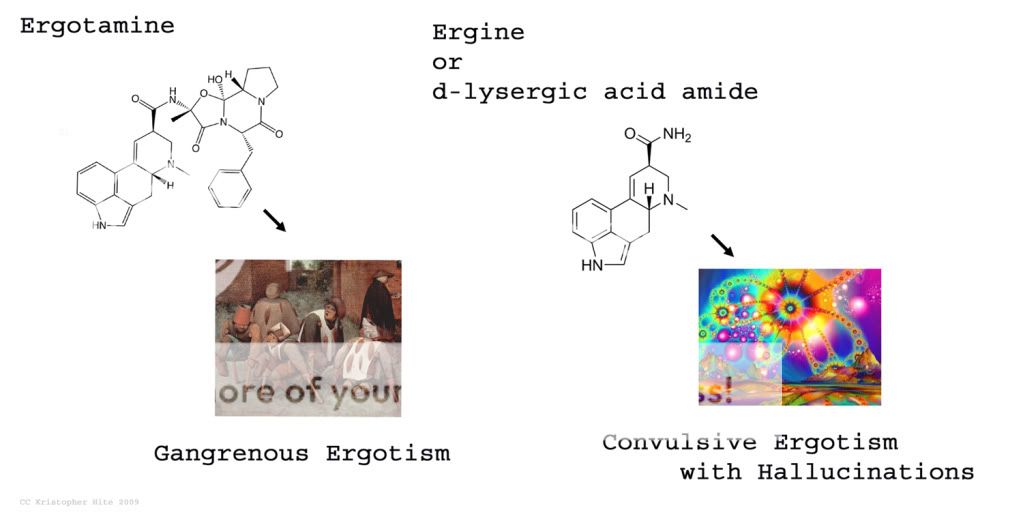
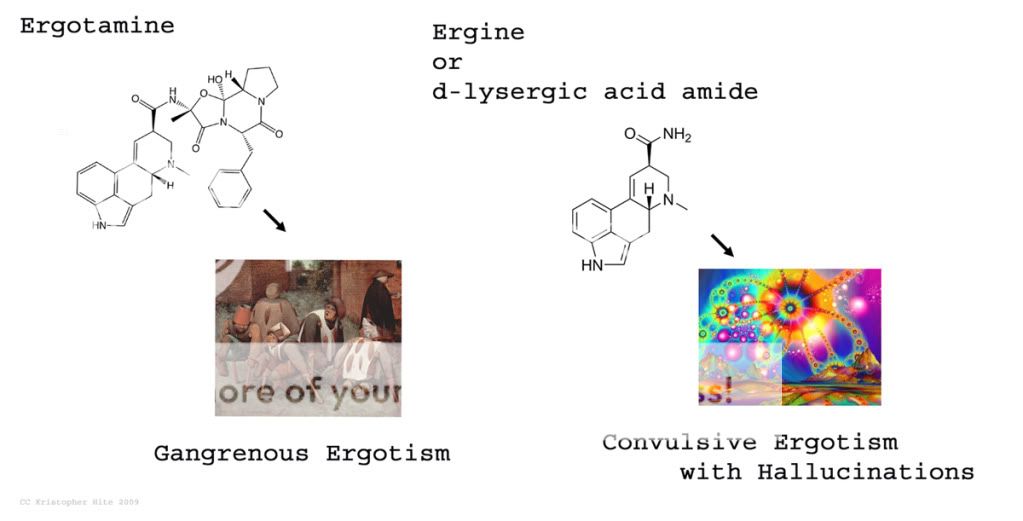
Mycotoxins contained in ergot infested rye caused two distinct varieties of ergotism. These toxins are known as the ergot alkaloids, and the two classes each have separate physiological effects - gangrenous or convulsive ergotism. Ergotamine, a powerful vasoconstrictor that prevents blood flow to the extremities, is the main culprit in gangrenous ergotism. Whereas ergine and lysergic acid hydroxyethylamide cause convulsive ergotism. These lysergic acid compounds have 10% the activity of the infamous psychoactive drug -LSD. Both LSD and the ergot alkaloids induce hallucinations by a similar and yet poorly understood mechanism. These compounds bind serotonin receptors in the brain as they are similar in shape and size to seratonin. It is not known how this induces hallucinations, but it is thought that agonist activity to serotonin releases higher concentrations of the neurotransmitter glutamate in the brain's cortex, exciting neurons in random ways. This would explain the varied psychological effects reported by individuals under the influence of this class of drugs.
By their activity, these compounds were known long before their chemical makeup was uncovered. Ergotamine had been used for nearly two centuries in midwifery to stop hemorrhaging after birth and also to induce abortion. In the first half of the 20th century the other ergot alkaloids were probed for other uses such as blood pressure and migraine treatments. A young chemist named Albert Hofmann, working for Sandoz pharmaceutical company in Basel, Switzerland, literally stumbled across LSD while performing organic synthesis of ergot alkaloids. His wild bicycle ride is a story of scientific lore worthy of its own post.
But here we are focused on the science behind medieval bewitching. The connection between ergotism and witch trials was first proposed by Linda Caporael in 1976 where she hypothesized in the Journal Science that Ergot could have been the real-world cause of the supposedly supernatural events that transpired in the village of Salem, Massachusetts in 1692.
In her paper, Caporael outlines the evidence for convulsive ergotism being the scourge that set off the string of hangings accompanying the infamous witch trials. Mainly, she points out that the symptoms of ergotism -spasms, the sensation of ants crawling under skin, and the feeling of being disemboweled - were all recorded by the court clerk when taking the testimony of the affected teenage accusers. Indeed, the very fact that the accusers were female and in their teens also implicates ergotism, as these are the most susceptible individuals in any community where there is an outbreak. Lastly, she turns to the geographic distribution of the bewitchment. Here she reconstructs a map of Salem village, where she hypothesizes that a contamination of grain grown on the eastern bank of the Wolleston river could have been the only source of ergot and still affected all the families involved.
Less than a year after her paper was published, skeptical scientists came in to refute her claims. Spanos and Gottlieb assert that Caporael is incorrect in her hypothesis and they give several reasons. They report that more townspeople should have shown signs of convulsive ergotism, that the afflicted girls did not testify to having exactly the same kind of symptoms expected from classic ergotism, and the town likely did not have a vitamin A deficiency that normally accompanies convulsive compared to gangrenous ergotism. Reading these rebuttals, there is no hard evidence in either direction which explains why this Science paper has not been retracted.
Despite this disagreement, Caporael's work inspired Mary Matossian to conduct further investigations into the possible connection between witch trials and ergotism outbreaks throughout the Middle Ages up until the 19th century. In her book Poisons of the Past Matossian lays out an incredibly convincing argument that outbreaks of ergotism indeed correlate to increased incidence of witch trials. She explains how tree ring data taken by x-ray measurements of tree ring density compiled for every year from 1269 - 1977 C.E. can be compared to an annual index of number of witch trials with statistical correlation in southwestern Germany and the Swiss alps.
Years where the growing season was cool and wet correspond to thicker tree rings and therefore seasons in which the amount of fungus growing amongst the rye was high. These long wet seasons directly preceded autumns with more witch trials. Like the medieval trials the Salem affair was also preceded by two years of unusually cold spring weather. Though there is evidence for a connection between ergot and witch trials in both Salem and the multitude of trials that took place in Europe throughout the Middle Ages, the evidence is stronger for the latter. In 2000 Alan Wolf, writing from the Harvard Medical School, further put the cabash on the Salem ergotism hypothesis. But if Carporeal had never posed the question, the work of Matossian may never have been conducted.
Further evidence for medieval outbreaks of both gangrenous and convulsive ergotism in Europe during the 16th century can be taken from a contemporary reporter. Transcending language and centuries the oil paintings of Pieter Bruegel the Elder give us an unusually clear window into recent human history. In the ergot alkaloid figure above a painting titled "the beggars" depicts peasants in what is now Belgium in the mid-1500s begging for food with stubs for limbs. Considering the geography and timing of these depictions, it is not difficult to imagine that these poor souls are suffering from gangrenous ergotism. Following his brush further we see in the 1562 painting below the story of Dull Gret or "Mad Meg" as she is known in English. Leading a band of paranoid peasant women, she storms the gates of hell, armed with cooking utensils, fearful that Spanish soldiers will pillage her village. "Mad Meg" of Flemish folklore may be under the influence of lysergic acid compounds found in Ergot!

When the imagery of Bruegel is conjured into mind, one can't help but wonder if generations of creative medieval minds weren't unwittingly dosed with background levels of the psychoactive components of Ergot.
As Samhain approaches, it is good to contemplate the possibility that some of the most infamous characters of all Hallows Eve may indeed have had very real biochemical origins.
I would like to thank Nick Clark for our many discussions and collaboration on this topic, and George Hudler for his kind advice and additional references and PowerPoint slides.
HUDLER, GEORGE W. Magical Mushrooms, Mischievous Molds. Princeton University Press, 1998. JSTOR, https://doi.org/10.2307/j.ctvs32r8v. Accessed 30 Oct. 2025.
Matossian, Mary Allerton Kilbourne. Poisons of the Past: Molds, Epidemics, and History. United Kingdom, Yale University Press, 1989.
Caporael, L. (1976). Ergotism: the satan loosed in Salem? Science, 192 (4234), 21-26 DOI: 10.1126/science.769159
Schweingruber, Fritz H., BrÄker, Otto U. & SchÄr, Ernst (1979). Dendroclimatic studies on conifers from central Europe and Great Britain Boreas, 8, 427-452
Schweingruber, Fritz H., BrÄker, Otto U. & SchÄr, Ernst (1979). Dendroclimatic studies on conifers from central Europe and Great Britain Boreas, 8, 427-452
Sunday, January 4, 2009
New York's "Obesity Tax"
A tale of aspartame and high fructose corn syrup.
 While home in New York State for the Christmas holiday political matters were generally not part of familial conversation. But one piece of legislation in New York was discussed. The new "obesity tax" on regular soda. This tax essentially attempts to deter people from drinking regular soda by adding an ¢18 charge per can. After contemplating the reasoning surrounding this law I believe the intention is good but the mark is missed. Mainly because all other food products with added high fructose corn syrup, and diet sodas are excluded from taxation.
I was a fat kid. In junior high I had to wear a special "fat kid" jersey on the basketball team. I know the torment so many kids are going through now because of their weight. Wanting to understand metabolism because of my battle against childhood obesity guided my choice to study biochemistry. I'm writing this because of that fat kid jersey.
The primary reason soft drink consumption is linked to obesity is the disproportionately large volumes in which soda is sold. 12, 24, 32, even 64 oz. containers are not unusual in our fast food nation. A simple solution to the soda problem would be to tax soda per individually packaged unit on an exponential scale for any container over 8 oz.
Super-sizing the soda portion was the way Pepsi Co. and Coca Cola dealt with plummeting soda prices in the 1980's. This depression in the supply/demand curve happened when the technology to turn regular corn syrup into the much sweeter high fructose corn syrup (HFCS) finally emerged from recombinant genetic research in Japan in the late 1970's. The soda companies, along with almost all other processed food companies, were quick on the uptake and in 1980 they swapped the more expensive imported cane sugar, for cheap domestically grown and processed HFCS. To stay profitable they upped the volume sold to the consumer. When I worked at my local cinema as a high school student my manager called this strategy "up-selling." I was told to ask the customers "you sure you don't want to upgrade that medium to a large? It's only ¢50 more."
In short, the American people fell for the old movie theater pop-corn trick. For nearly 30 years our average caloric intake from soft drinks has gone up and up and up. Michael Pollan explains this phenomenon in greater depth from page 100-108 in the Omnivore's Dilemma.
But simply reducing the volume would be far too easy a solution for our high-tech world. Why rain on Pepsi Co./Coca Cola's parade? Why not make money on the other side. Run billions of ads for weight loss programs, machines, lipo-suction, Richard Simmons and that guy with the pony-tail. Why attack the cause when there is so much money to be made in the clean-up?
Speaking of money to be made on the other side of obesity, I'd like to focus on Aspartame, aka NutraSweet. This compound  actually promotes sugar uptake from other dietary sources. This means that an individual that only consumes diet soda and no other food or beverage would indeed loose weight, but any other sugary or fatty food consumed by an individual drinking a NutraSweet drink absorbs those other calories more readily.
I would love to see a scientific paper that is not blocked by the soda, or artificial sweetener companies on weight gain in mice fed aspartame vs. cane sugar. The paper I am proposing would include a control group of mice (fed a normal diet with no added sugars), one experimental group fed a normal diet and 1 gram of cane sugar per day and a second experimental group fed a normal diet and 1 gram of aspartame per day. If the hypothesis that aspartame promotes the uptake of glucose is correct the group of mice being fed the NutraSweet should be heavier than either of the other groups.
There is another disturbing twist in the legend of aspartame. One of the main proponents that pushed legislation through the FDA to allow aspartame to be used as a food additive for mass consumption was the chief operating officer of G.D. Searle and Company - Mr. Donald Rumsfeld. 
Mr. Rumsfeld re-applied for the FDA to approve aspartame within the first few months of Ronald Regan's presidency. He filed the application despite the fact that the FDA had rejected the initial application because of unclear data relating to observed brain cancer in mice fed aspartame. The relative value Mr. Rumsfeld has placed on human life when reckoning business transactions gives me little reason to believe this man would care to look at any negative evidence about something he wanted the American people to buy into, whether it was war or soft drinks.
A recap - Solutions include; changing the tax language to include all products with added high fructose corn syrup, an exponential tax scale for all beverage containers over 8 ounces, and a ban on all artificial sweeteners until long term biological effects can be thoroughly studied.
In the meantime, raise a small glass of cane-sugar-sweetened cola; to the end of the Rumsfeld, Wolfowitz, Cheney, Bush error!!!
Cheers!
~The Ghost
Friday, October 31, 2008
Biochemistry of Halloween: Installment 1
By Kristopher Hite
"A Candle in the Dark"
Teeth lengthened by receding gums glow in the shaded valleys of the Carpathian basin. The genetic milieu of the Visigoths, Huns, Carpians, and Slavic peoples have swirled over centuries as granite crags pushed populations into shallow gene pools. A ghoulish thing of legend emerged from Transylvania and has since soaked literature and pop-culture with a reddish froth. Science and medicine have given us reason not to fear for our necks in a story that is truly stranger than fiction...
The glowing teeth mentioned earlier occur because of an accumulation of light sensitive molecules called porphyrins in victims of a rare genetic disease. Porphyria affects one of the steps in heme production. A heme is the chemical group that holds iron atoms in their proper position in hemoglobin (the protein of blood). The name "porphyria" came from the Greek words for purple and pigment. Victims of this disease have an uncanny similarity to historical descriptions of vampires and phenotypes of this disease have been suggested as possible explanation for the origin of vampire legends.
Mal-formed porphyrin molecules accumulate in affected people's skin and teeth. When activated by light these molecules activate oxygen molecules into destructive radicals that can wreak havoc on surrounding tissue. When exposed to light individuals appear to be burned with caustic lesions left on their skin. Enter: Nosferatu's pale countenance shrieking in terror as the sun rises.
 Though no blood-lust is reported by sufferers some historians speculate that drinking the blood of animals may have been attempted as a folk remedy in treating the disease. It has since been proven that the heme molecule is in fact robust enough to survive digestion indicating that replenishing mal-formed blood molecules by drinking blood may indeed help those that happen to exhibit anemia in conjunction with porphyria. When watching vampire movies the whole garlic premise never made any sense to me. Why couldn't you use mushrooms, or cinnamon, or toothbrushes to scare away vampires? What was it about garlic. With the Porphyria hypothesis in mind it makes sense however. Garlic has vasso-dilator chemicals and is reported to exacerbate the affects of porphyria. Sufferers may have learned to avoid it indeed!
In the genetically secluded valleys of Transylvania it is not hard to imagine disorders like these occurring more than expected in a diverse population. Before the renaissance and the spread of the scientific revolution a vampire myth may have grown from accounts of these individuals with their glowing long teeth, aversion to sun and garlic, and maybe even sucking blood in the night!
Thanks Nick for your help with this!!! stay tuned for the next installment of the Biochemistry of Halloween when we talk about Haitian Zombies!
Friday, October 10, 2008
Behold! A Beautifully Bountiful Beta Barrel

Green Fluorescent Protein - The discovery and development of this biochemical flashlight was awarded the Nobel prize in chemistry this week. Three great brains were awarded the Nobel for GFP, Osamu Shimomura, Martin Chalfie and Roger Tsien.

Osamu Shimomura (Woods Hole, Mass) - First isolated the protein from the outer bell of the crystal jellyfish in Washinton state in 1962.

Martin Chalfie (Columbia) - First used GFP to tag a protein in a living system (the model organism c. elegans). This method of tagging recombinant proteins then observing them is cells and whole organisms has become one of the most common techniques in bio-medical research.

Roger Tsien (UC San Diego) - Developed a whole rainbow of fluorescent proteins. This allows multiple proteins to be tagged at once and distinguished in living systems.
The observations made possible by the advent of GFP as a molecular candle are by all means amazing and good. However, I could not help but cringe when I saw the picture below of two adolescent Macaque primates who had been genetically modified with a bad Huntington's disease gene tagged with GFP. This image was published in a research paper in the Journal Nature - spring 2008. This represents an image issue science has had since the late 20th century as socially irresponsible.

Subscribe to:
Posts (Atom)