Showing posts with label bioethics. Show all posts
Showing posts with label bioethics. Show all posts
Friday, February 23, 2018


Saturday, June 22, 2013
Sunday, September 2, 2012
Atheist Morality: Ratcheting Forward
By Kristopher Hite
As a person with no religion and no belief in any gods, it may come as a surprise that I spend considerable time thinking about the best source of moral guidance. Throughout history there have been people who maintain a good reputation, a high quality of life, and provide constant intellectual stimulation to their peers while actively questioning what is right and wrong. Who are these people in present day and what do they have to say?
Dr. Ken Miller is a cell biologist and professor at Brown University. He is famous for defending evolution as a fundamental subject in biology classrooms and has given testimony in several important court cases. The most recent being Kitzmiller v. Dover, PA. By doing so he has elevated the quality of public education in the United States and helped ensure evolution be taught as a matter of fact. Through his work he has upheld the establishment clause fo the US constitution and for this I applaud him.
As for moral thought, Dr. Miller has gone on record saying that "science can only take us so far." I was able to ask him to elaborate on this thought last week as part of a Google Hangout On Air moderated by the HuffPostLive host Josh Zepps. I asked him where atheists ought to get their morals and where he gets his. Here was his response.
Fellow blogger, Cara Santa Maria chimed in via the Huffpost discussion informing me that she had recently recorded a pertinent episode of "the Point" a spin-off of the the Young Turks Network. The episode was essentially a panel discussion of exclusively atheists trying to answer the question "where does atheist morality come from?"
As part of the panel discussion, video comments were aired as food-for-thought. To me, the most striking guest was AJ Johnson, Development Director for the American Atheists organization. Here is her comment.
Physicist and blogger Sean Carroll responded to her comment with a plea to atheists to heed her words and to try harder to actively participate in the process of developing an atheist morality. Here is Sean.
PZ Myers is one of these leaders. A professor of biology at the University of Minnesota at Morris PZ writes one of the most widely read blogs on the planet. Being in the right place at the right time, PZ has the unique position of wielding a mighty horde or electronic followers numbering in the hundreds of thousands. When he asks them to do something, they do it en masse. This can be seen any time he asks them to crash some bogus internet poll which they do in throngs. This kind of klout is not to be taken lightly. Though PZ has been dogged as being odious and even a "shepherd of internet trolls" by thinkers like Sam Harris, in my opinion PZ has made some excellent points lately. I think he has some moral guidance to offer in explaining secular morality more precisely as Sean Carroll has challenged us to do. The following passage penned by PZ appears in the latest issue of Free Inquiry, titled Atheism’s Third Wave.
Thank you for reading. I hope that as a peer you will leave a comment below and tell me where you get your sense of right and wrong so I might share your wisdom.
As a person with no religion and no belief in any gods, it may come as a surprise that I spend considerable time thinking about the best source of moral guidance. Throughout history there have been people who maintain a good reputation, a high quality of life, and provide constant intellectual stimulation to their peers while actively questioning what is right and wrong. Who are these people in present day and what do they have to say?
Dr. Ken Miller is a cell biologist and professor at Brown University. He is famous for defending evolution as a fundamental subject in biology classrooms and has given testimony in several important court cases. The most recent being Kitzmiller v. Dover, PA. By doing so he has elevated the quality of public education in the United States and helped ensure evolution be taught as a matter of fact. Through his work he has upheld the establishment clause fo the US constitution and for this I applaud him.
As for moral thought, Dr. Miller has gone on record saying that "science can only take us so far." I was able to ask him to elaborate on this thought last week as part of a Google Hangout On Air moderated by the HuffPostLive host Josh Zepps. I asked him where atheists ought to get their morals and where he gets his. Here was his response.
His answers only lead me to more questions. Which philosophical views help provide the greatest good? And what time-scale for good should we choose? If not from science then where do these ideas originate? And how are contemporary atheists doing on developing a moral code?If, in science, we found an absolute, testable, empirical source of morality then scientists everywhere would agree on all moral questions. The reality is I think our discussions of morality, in other words, what is right and wrong, have to be informed by science. I think we have to be literate in science, even people who are not scientists. But ultimately moral questions require a philosophical point of view in terms of what is the good life? How should we treat each other? What is the value of human life? Now as a Catholic, I have to confess, I draw a lot of my moral sense from the religious teachings of my faith. But I also would argue that there is a moral sense that is present in everybody. Whether they are a person of faith, whether they are an agnostic, or whether they are an atheist. I completely agree with the idea that one can have an atheistic world-view. And informed by science, and by using logic, and by having a philosophical view on life, you can in fact, develop a moral code which is consistent and which provides the greatest good for the greatest number.

Fellow blogger, Cara Santa Maria chimed in via the Huffpost discussion informing me that she had recently recorded a pertinent episode of "the Point" a spin-off of the the Young Turks Network. The episode was essentially a panel discussion of exclusively atheists trying to answer the question "where does atheist morality come from?"
As part of the panel discussion, video comments were aired as food-for-thought. To me, the most striking guest was AJ Johnson, Development Director for the American Atheists organization. Here is her comment.
Physicist and blogger Sean Carroll responded to her comment with a plea to atheists to heed her words and to try harder to actively participate in the process of developing an atheist morality. Here is Sean.
At this point you may say "we can look to evolution and neurobiology for our moral origins. We can see how justice plays out in animals. We can look to cognitive neuroscientists like Josh Greene who can tell us the average response to moral dilemmas in the fMRI scans of human brains. We can use this scientific data to rationalize a fair system for human society. Right?" Wrong says Sean Carroll.AJ Johnson brings up a really important point when she says secularists should "own" their superior morality. I think that we have been on the defensive for a very long time because traditionally the reason why things were "right and wrong" ultimately flowed from God. God was helping us explain what is good, and what is bad. Of course God does not exist. But we haven't, as secularists, really given a good explanation of where our morality comes from. And partly, it's because we don't know. Figuring out how to act in the world without guidance from outside anywhere is a very difficult problem. We say nice things about equality and liberty and things like that. But we don't agree on the underlying philosophy. We don't have the cheap out of saying "well, here's the holy book where its all been written down." We have to think about things. And I think we need to do a better job.

You do not want to commit the naturalistic fallacy. You do not want to say that because things happen in nature that they are the right things to have happen. We need explain the fundamental reason for saying that some behavior is good, some behavior is bad. I think that evolution helps us explain why we have the predilections we do. And evolution is certainly going to play a crucial role in an ultimate understanding of morality, but it does not GIVE it to us in any simple way. We should be able to do better than that.If science can not tell us where morality comes from, then what can? As atheists shouldn't we be skeptical of any idea that can not be explained with the scientific method? I'll give you my answer. Yes we should be skeptical of pure moral philosophy but that does not mean we should shut our ears to it. Much can be learned from living people as they have the highest probability of experiencing the same existential questions you have. The very term "humanist" implies that we ought embrace our peers and draw our ethics from them. There are currently very powerful leaders in the atheist community, like it or not. Though we do not hold these leaders as infallible vessels of an invisible sky-father there is a large collective of minds tuned-in to their thoughts via the internet.
PZ Myers is one of these leaders. A professor of biology at the University of Minnesota at Morris PZ writes one of the most widely read blogs on the planet. Being in the right place at the right time, PZ has the unique position of wielding a mighty horde or electronic followers numbering in the hundreds of thousands. When he asks them to do something, they do it en masse. This can be seen any time he asks them to crash some bogus internet poll which they do in throngs. This kind of klout is not to be taken lightly. Though PZ has been dogged as being odious and even a "shepherd of internet trolls" by thinkers like Sam Harris, in my opinion PZ has made some excellent points lately. I think he has some moral guidance to offer in explaining secular morality more precisely as Sean Carroll has challenged us to do. The following passage penned by PZ appears in the latest issue of Free Inquiry, titled Atheism’s Third Wave.
I went to see President Obama speak in Colorado last week. During his speech he echoed this sentiment of equality and inclusiveness. He pointed out that the history of the United States has seen protection under the law and participation in government become more and more inclusive. He described that process as a ratchet in which progress only goes forward. It is my sincere hope that unprecedented personal connectivity can couple to decentralized information and push the ratchet of progress even further. Maybe even so far as to see an open-atheist as a viable candidate for major political office one day.
Professor and blogger PZ Myer Science is neutral on moral concerns; it only describes what is, not how it ought to be. And this is true; science is a tool that can be used equally well for curing diseases or building bombs. But scientists are not and should not be morally neutral, nor should scientific organizations or culture be excluded from defining the appropriate uses of science. Science without humanist moral standards leads to Mengele or the Hiroshima bombing or the Tuskegee syphilis experiments.
Similarly, atheism may be value-neutral, but atheists and atheist organizations should not be. Atheism sensu stricto may be a specific assertion about a fact of the universe, but atheism as practiced is a defining idea in a mind and a powerful foundation for a human community. It has meanings and implications that we must heed and use for achieving our goals.
And what should those goals be? Because I’m an atheist and share common cause with every other human being on the planet in desiring to live my one life with equal opportunity, I suggest that atheists ought to fight for equality for all, economic security for all, and universally available health and education services. Peace is the only answer; extinguishing a precious human life ought to be unthinkable in all but the most dire situations of self-defense. Ours should be a movement that welcomes all sexes, races, ages, and abilities and encourages an appreciation of human richness. Atheism ought to be a progressive social movement in addition to being a philosophical and scientific position, because living in a godless universe means something to humanity.

Thank you for reading. I hope that as a peer you will leave a comment below and tell me where you get your sense of right and wrong so I might share your wisdom.
Friday, April 13, 2012
Rebecca Skloot on science journalism
During a 2010 visit to her alma mater - Colorado State University - Rebecca Skloot gave a series of seminars on communicating science to the public. I asked her what she thought about the role of science journalism in a world where more and more scientists are communicated directly to the public. Here is her answer.
Sunday, December 7, 2008
Sunday Celebration - Hyperrealism
By Kristopher Hite
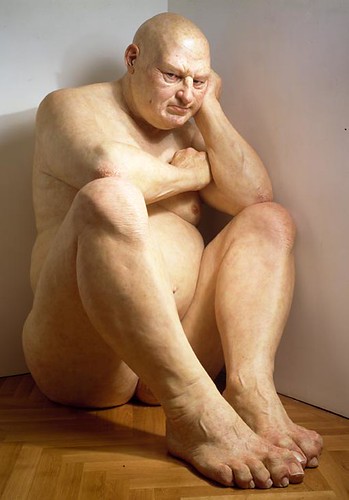
 Free expression through sculpture. I wanted to write a tirade today about how much I loathe the work of Mark Rothko but instead decided to accentuate the positive with a tip of the hat to a relatively new realm of art - hyperrealism. My first encounter with this style was at an actual art gallery in Akron, Ohio. I turned around the corner after scratching my head in front of some post-modern canvas splats into a clean white-walled gallery where I was startled at the sight of a naked giant sitting in the corner. This was part of a traveling exhibit by the Australian sculptor Ron Mueck. He uses silicone and fiberglass along with paint and polyesters applied directly to cast molds of the human form. This creates an effect that surpasses reality in fooling the observer into thinking the piece has a heartbeat, bluish veins and all. By constructing the works on anomalous scales from the very large to the very small the impressive effects of these works are amplified. It was not shocking for me to learn that Mr. Mueck had worked with Jim Henson, specifically collaborating on The Labyrinth and the Story Teller series with John Hurt, as the later had a lasting impression on my imagination as a child. Trolling the web for the antithesis of Rothko I came across the works of another hyperrealist worth noting, especially considering the slant of her subject matter.
 Patricia Piccinini has a new exhibit at the Roslyn Oxley9 gallery in Sydney, Australia. Along with Mueck's brand of stark realism, she injects a healthy dose of organic philosophy into her sculptures. She forces the observer into an uncomfortable state while captivating attention with the painstaking detail. Her interest in the areas of bioethics and the environment show themselves to the observer through the human spirit buried within her monstrosities. Artists and artists like this seem to be ushering in an era of real post-post-modernism. Gone are the easy days of slapping some inky utensil around on a surface and asking the world to think about it. To do what these artists do a great deal of training and practice is necessary. This gives the artist's class a renewed respect as focused innovators rather than frizzled drug addicts, while still maintaining a radical voice in abstraction!
The work of Patricia Piccinini brings the philosophical/scientific ven diagram into focus. If we have the ability to do something new, should we? or would it result in something ghastly? This question was recently asked in Slate about cloning Neandretals and has been the topic of debate since the publication of Mary Shelly's Frankenstein. No one knows the answer, and if they think they do then our species should just stop thinking so hard and take our place in the geologic record. Jurassic Park was on television last week and all I could think about was how much respect I had lost for Michael Crichton when I read State of Fear. This book is a fictional account of envronmentalists/terrorists who attempt to fool the world into believing in global warming by orchestrating storms and laser induced sea level rising. I lost even more respect when I heard he met George w. Bush in 2005 to council him on the "greatest hoax ever perpetrated on the American people." When Jurassic Park came out in theaters I was too young to appreciate reading and I ate that movie up, every bit of it. The animatronics, the acting, the story, I loved it all. What I was not aware of was the ripples of philosophical fear a story like this would send through the consciousness of the general populous. "Scientists will destroy humanity with their insatiable fervor and lust for power and control over god's creation!" Michael Crichton may be in Mensa but he knows not what he does. He erodes the promise of the enlightenment and the general consensus that the United States was founded on. The idea that improvement of the human condition is perpetually possible. He would relegate us to a happy status quo where complacency is celebrated. A world where the scientific method is distrusted is a world where children can be denied vaccines and denied exposure to the education required for them to contribute to progress. Laws can not change the conscience of the people, but voices, keyboards, and pens can.
Free expression through sculpture. I wanted to write a tirade today about how much I loathe the work of Mark Rothko but instead decided to accentuate the positive with a tip of the hat to a relatively new realm of art - hyperrealism. My first encounter with this style was at an actual art gallery in Akron, Ohio. I turned around the corner after scratching my head in front of some post-modern canvas splats into a clean white-walled gallery where I was startled at the sight of a naked giant sitting in the corner. This was part of a traveling exhibit by the Australian sculptor Ron Mueck. He uses silicone and fiberglass along with paint and polyesters applied directly to cast molds of the human form. This creates an effect that surpasses reality in fooling the observer into thinking the piece has a heartbeat, bluish veins and all. By constructing the works on anomalous scales from the very large to the very small the impressive effects of these works are amplified. It was not shocking for me to learn that Mr. Mueck had worked with Jim Henson, specifically collaborating on The Labyrinth and the Story Teller series with John Hurt, as the later had a lasting impression on my imagination as a child. Trolling the web for the antithesis of Rothko I came across the works of another hyperrealist worth noting, especially considering the slant of her subject matter. Patricia Piccinini has a new exhibit at the Roslyn Oxley9 gallery in Sydney, Australia. Along with Mueck's brand of stark realism, she injects a healthy dose of organic philosophy into her sculptures. She forces the observer into an uncomfortable state while captivating attention with the painstaking detail. Her interest in the areas of bioethics and the environment show themselves to the observer through the human spirit buried within her monstrosities. Artists and artists like this seem to be ushering in an era of real post-post-modernism. Gone are the easy days of slapping some inky utensil around on a surface and asking the world to think about it. To do what these artists do a great deal of training and practice is necessary. This gives the artist's class a renewed respect as focused innovators rather than frizzled drug addicts, while still maintaining a radical voice in abstraction!
The work of Patricia Piccinini brings the philosophical/scientific ven diagram into focus. If we have the ability to do something new, should we? or would it result in something ghastly? This question was recently asked in Slate about cloning Neandretals and has been the topic of debate since the publication of Mary Shelly's Frankenstein. No one knows the answer, and if they think they do then our species should just stop thinking so hard and take our place in the geologic record. Jurassic Park was on television last week and all I could think about was how much respect I had lost for Michael Crichton when I read State of Fear. This book is a fictional account of envronmentalists/terrorists who attempt to fool the world into believing in global warming by orchestrating storms and laser induced sea level rising. I lost even more respect when I heard he met George w. Bush in 2005 to council him on the "greatest hoax ever perpetrated on the American people." When Jurassic Park came out in theaters I was too young to appreciate reading and I ate that movie up, every bit of it. The animatronics, the acting, the story, I loved it all. What I was not aware of was the ripples of philosophical fear a story like this would send through the consciousness of the general populous. "Scientists will destroy humanity with their insatiable fervor and lust for power and control over god's creation!" Michael Crichton may be in Mensa but he knows not what he does. He erodes the promise of the enlightenment and the general consensus that the United States was founded on. The idea that improvement of the human condition is perpetually possible. He would relegate us to a happy status quo where complacency is celebrated. A world where the scientific method is distrusted is a world where children can be denied vaccines and denied exposure to the education required for them to contribute to progress. Laws can not change the conscience of the people, but voices, keyboards, and pens can.
Friday, October 10, 2008
Behold! A Beautifully Bountiful Beta Barrel

Green Fluorescent Protein - The discovery and development of this biochemical flashlight was awarded the Nobel prize in chemistry this week. Three great brains were awarded the Nobel for GFP, Osamu Shimomura, Martin Chalfie and Roger Tsien.

Osamu Shimomura (Woods Hole, Mass) - First isolated the protein from the outer bell of the crystal jellyfish in Washinton state in 1962.

Martin Chalfie (Columbia) - First used GFP to tag a protein in a living system (the model organism c. elegans). This method of tagging recombinant proteins then observing them is cells and whole organisms has become one of the most common techniques in bio-medical research.

Roger Tsien (UC San Diego) - Developed a whole rainbow of fluorescent proteins. This allows multiple proteins to be tagged at once and distinguished in living systems.
The observations made possible by the advent of GFP as a molecular candle are by all means amazing and good. However, I could not help but cringe when I saw the picture below of two adolescent Macaque primates who had been genetically modified with a bad Huntington's disease gene tagged with GFP. This image was published in a research paper in the Journal Nature - spring 2008. This represents an image issue science has had since the late 20th century as socially irresponsible.

Tuesday, September 30, 2008
Freedom of the Genetic Press? Can newly created letters of life's alphabet be patented?
Life is written in a language of chemical sentences. In 2006 a group of researchers began the process of engineering new letters to be incorporated into genetic alphabet. The naturally occurring genetic alphabet is made up of 20 chemical letters (amino acids). These letters are arranged in the correct order by molecular machines called ribosomes into words that make sense (proteins). There are words of all sizes that perform key functions in all organism, from two letter hormones to the epic 26,000 lettered titan muscle protein. Each of the 20 naturally occurring amino acids is known by the translating machinery to correspond to a sequence of three specific nucleotide bases (codons). Because there are four nucleotide bases and they come together in groups of three (4x4x4 = 64) there are 64 different combinations of these base pairs. Because there are only 20 naturally occurring amino acids and 64 ways to code for them that leaves 44 options left open to code for other things. Nature uses most of these extra codons as redundant codes for the same amino acid so some letters will have 2-6 different codes all calling for the same letter. But there are some of these extra codons that are nonsensical and do nothing apparently useful. What this research group did was take advantage of these extra three letter codons and engineered a special translator molecule known as transfer RNA or tRNA that they attached to new unnatural letters - (man made amino acids).
The mind blowing novelty of this expanded genetic alphabet is only now being realized for practical purposes. With new man made letters within nature's alphabet of life researchers are taking this patented technology and using it to create Frankenstein proteins with diverse and useful features like hemoglobin mimicry and in cell localization. This process will be at the heart of synthetic biology. The question stands... Is a patent for an unnatural letter allowed? Apparently so according to the US government's patent office. But does that mean that I could invent new letters for the English alphabet and patent them to make a profit if others eventually use them?

The mind blowing novelty of this expanded genetic alphabet is only now being realized for practical purposes. With new man made letters within nature's alphabet of life researchers are taking this patented technology and using it to create Frankenstein proteins with diverse and useful features like hemoglobin mimicry and in cell localization. This process will be at the heart of synthetic biology. The question stands... Is a patent for an unnatural letter allowed? Apparently so according to the US government's patent office. But does that mean that I could invent new letters for the English alphabet and patent them to make a profit if others eventually use them?

Subscribe to:
Posts (Atom)