Showing posts with label witches. Show all posts

Thursday, October 31, 2013

Vampire Phylogeny


"Teeth lengthened by receding gums glow in the shaded valleys of the Carpathian basin. The genetic milieu of the Visigoths, Huns, Carpians, and Slavic peoples have swirled over centuries as granite crags pushed populations into shallow gene pools. A ghoulish thing of legend emerged from Transylvania and has since soaked literature and pop-culture with a reddish froth. Science and medicine have given us reason not to fear for our necks in a story that is truly stranger than fiction... "

Thus begins one of my most successful Blog Posts.  The idea to write up this particular hypothesis on a biochemical etiology of vampires was born on a fall day in 2008. A fellow graduate student at Colorado State - Nicholas Clark and I were talking about "talking about science" to the public.  We decided a useful method to engage the public would be to hook them in with a popular topic and then sneak in some hardcore biochemistry.  So we did it. We planned a "Biochemistry of Halloween" lecture and delivered it the following fall.  There were 60-70 people in attendance and the talk was wildly popular. So popular in fact that Nick and I were invited to present the talk for the Colorado State Alumni association at the Park Hill library in Denver the following year. This time there were more people from the general public and our presentation was met with even greater enthusiasm.  One of the attendees even came up to us afterwards and asked us for all our references as she was particularly interested in the porphyria/vampire hypothesis as her ex had a form of the disease and was now in jail for attempting to slit her throat with a paring knife.

After this experience I have been hesitant to present this talk because I feared it may be taken the wrong way. As if we were saying "people with porphyria are vampires." This is not what we were trying to get across. I have since finished graduate school and moved on to a postdoc at Emory University in Atlanta. Nick is Postdocing at NIST near Washington DC. 

Recently, I took it upon myself to raise the talk from the dead. I presented it at Nerd Nite Atlanta at Manuel's Tavern on October 16th, 2013.  I also amended the talk to include several disclaimers about porphyria patients and attempt to address the stigma that has recently become associated with this very serious genetic disease. I felt much better about the talk this time and it was well-received by an enthralled audience though it was not the same without Nick and his unique knowledge-set on the biochemistry of Zombies and Zombification. 

Saturday, October 13, 2012

Witches, tree-rings, and LSD

In the moonlight mothers and fathers watched the shriveled toes of a poor beggar swing from the gallows. They placed their faith in God that the death of this "witch" might take away the torment, fits, and visions that plagued their children. That somehow through supernatural forces the sensations of ants crawling underneath their skin, delusions of bursting into flames, and frenzied shrieks of terror in the night would cease. As the the seasons brought new harvests the number of swinging bodies dwindled. But bouts of bewitchment would visit the same valleys for centuries.

This was a typical scene in the medieval villages that lined the Rhône and Rhine rivers. Here, and in other curiously coincidental micro-climates all over Europe something dark and treacherous lurked in the farm fields.

During the cold, wet harvest seasons a deep purple fungus Claviceps purpurea reared its ugly sclerotium amongst the ears of rye. Looking much like the rooster's spur the killer was given the french name - erogot. When rye was milled the flour could contain up to 30% ergot by dry weight. And so it goes that the biochemistry of bewitchment had its origins under the millstones of fifteenth century Europe. 

During this age the peasantry ate an enormous proportion of the darker cheaper rye; upwards of three pounds a day. As the chemicals made by the ergot made their way into the blood and brains of those apparently seized by demons, the unaffected were left to assume they had been bewitched. The linguistic fossil preserved in the very word - seizure - describes the uncontrolled fits the affected displayed. A condition known at the time as "St Anthony's fire"  (aka Ignis Sacer) did not become known as ergotism until 1853 when the clinical connection to the fungus was finally made.

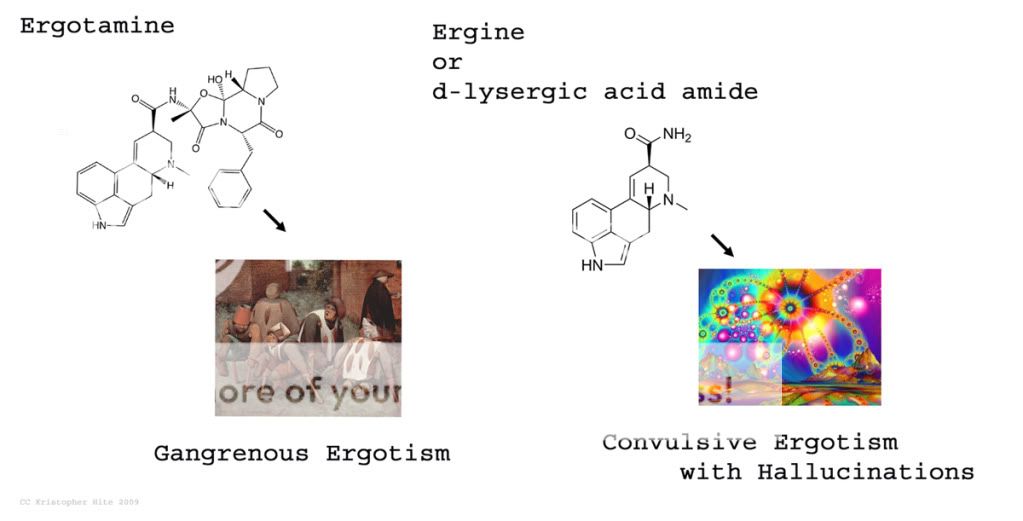
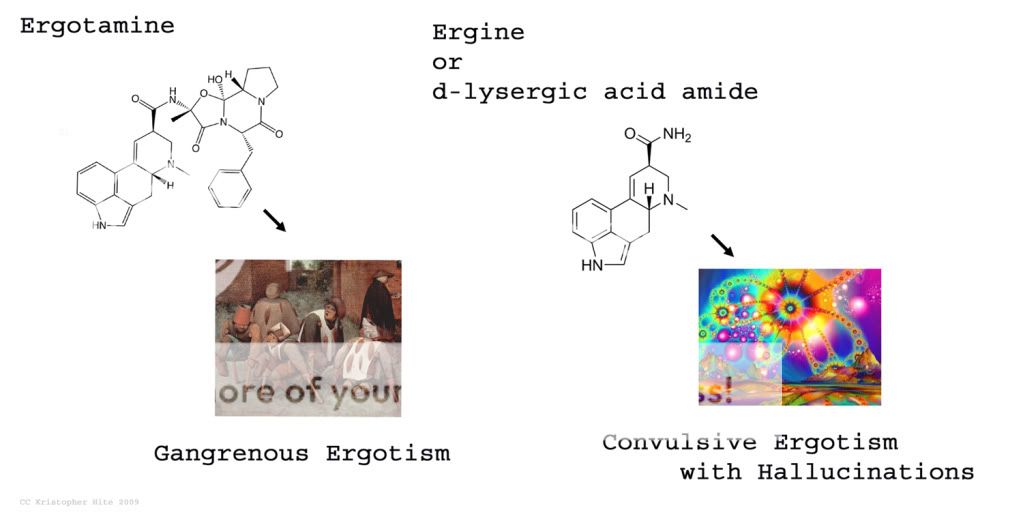
Mycotoxins are poisons produced by fungi and mold. The variety of mycotoxins contained in ergot-infested rye cause two distinct varieties of ergotism - gangrenous or convulsive ergotism. Ergotamine, a powerful vaso-constrictor, prevents blood flow to the extremities and is the main culprit in gangrenous ergotism.  Whereas ergine and lysergic acid hydroxyethylamide cause convulsive ergotism. These lysergic acid compounds found in the ergot fungus have similar effects on the human brain as the psychoactive drug - LSD.  Both LSD and the ergot alkaloids induce hallucinations by a similar and yet poorly understood mechanism.  Structurally similar to serotonin these compounds bind serotonin receptors in the brain. It is not known how this induces hallucinations but it is thought that agonist activity to serotonin releases higher concentrations of the neurotransmitter glutamate in the brain's cortex exciting neurons in random ways.  This would explain the varied psychological effects reported by individuals under the influence of this class of drugs.

By their activity these compounds were known long before their chemical makeup was uncovered. Ergotamine had been used for nearly two centuries in midwifery to stop hemorrhaging after birth and also to induce abortion. In the first half of the 20th century the other ergot alkaloids were probed for alternative medical uses such as blood pressure and migraine treatments.  A young chemist named Albert Hofmann working for Sandoz pharmacueitcal company in Basel, Switzerland literally stumbled across LSD while performing organic synthesis of ergot alkaloids.  His wild bicycle ride is a story of scientific lore worthy of its own post.

But here we are focused on the science behind medieval bewitching. The connection between ergotism and witch trials was first proposed by Linda Caporael in 1976 where she hypothesized in the Journal Science that Ergot could have been the real world cause of the supposedly supernatural events that transpired in the village of Salem, Massachusetts in 1692.  
 
In her paper Caporael outlines the evidence for ergotism being the scourge that set off the string of hangings accompanying the infamous witch trials in Salem.  She points out that the symptoms of ergotism; spasms, the sensation of ants crawling under skin, and the feeling of being disemboweled - were all recorded by the court clerk when taking the testimony of the affected teenage accusers.  Indeed the very fact that the accusers were female and in their teens also implicates ergotism as these are the most susceptible individuals in any community where there is an outbreak.  Lastly, she turns to the geographic distribution of the bewitchment. Here she reconstructs a map of Salem village where she hypothesizes that a contamination of grain grown on the eastern bank of the Wolleston river could have been the only source of ergot and still affected all the families involved.
  
Caporael's work inspired historian Mary Matossian to conduct further investigations into the possible connection between witch trials and ergotism outbreaks throughout the middle ages up until the 19th century.  In her book Poisons of the Past Matossian lays out an incredibly convincing argument that outbreaks of ergotism indeed correlate to increased incidence of witch trials throughout the medieval period.  She explains how tree ring thickness measurements compiled for every year from 1269 - 1977 C.E. can be compared to an annual index of number of witch trials with statistical correlation in southwestern Germany and the Swiss alps. 
 
Years in which the growing season was cool and wet correspond to thicker tree rings and therefore seasons in which the amount of fungus growing amongst the rye was high.  These long wet seasons directly preceded autumns with more witch trials. Like the medieval trials the Salem affair was also preceded by two years of unusually cold spring weather.

I was and still am utterly fascinated by the potential connection between a nefarious fungus and the waves of witch trials throughout the middle ages. So fascinated that I have continued seeking further evidence for this biochemical culprit in primary sources.  As I have said, the mid-wives of medieval Europe knew how to use ergot to treat hemorrhaging after birth, but did they know they could use this fungus to induce abortion? Surely they must have, and this would only have placed them higher on the list of public enemies by church rulers. Interesting observation, but how can I use this bit of information to test the claim that the presence of ergot in the diet of medieval peoples lead to witch trials?

There was a guide-book to hunting witches written in Germany in 1486 and approved by the papcay - the Malleus Maleficarum. Translated to English from Latin this means "the hammer of the witches."
The main purpose of the Malleus was to attempt to systematically refute arguments claiming that witchcraft does not exist, discredit those who expressed skepticism about its reality, to claim that witches were more often women than men, and to educate magistrates on the procedures that could find them out and convict them.
Might I use this primary text to hunt for clues connecting ergot to geographic regions affected by witchcraft?   Ergot can induce abortion in humans, right? Well, ergot in rye can also induce abortion in cattle. With this fact in mind I went to the text of the Malleus which is available through Google Books and project Gutenberg. When I searched in the book for the word "cattle" I found several references and even a whole chapter on how witches injure cattle in various ways. To my astonishment, there was even mention of bewitched cattle spontaneously aborting their calves! To the witch-hunters and inquisitors of the middle ages this phenomenon was a sign of witchcraft but the reality was most likely a rotten rye crop!

Thanks for reading! I hope you liked this story. If you did please share it! I would like to make this part of a storytelling series I am planning on you tube. Stay tuned here in the coming weeks for more biochemistry of Halloween content! You can subscribe to Tom Paine's Ghost at the link in the upper-right sidebar. If you like what you read here please make a donation of any size so I can continue to do what I love :)  Donate button also in the sidebar.

I would like to thank Nick Clark for our many discussions and collaboration on this topic and George Hudler for his kind advice and additional references.


Caporael, L. (1976). Ergotism: the satan loosed in Salem? Science, 192 (4234), 21-26 DOI: 10.1126/science.769159  

Schweingruber, Fritz H., BrÄker, Otto U. & SchÄr, Ernst (1979). Dendroclimatic studies on conifers from central Europe and Great Britain Boreas, 8, 427-452  

Saturday, October 31, 2009

The Biochemistry of Halloween: Installment II

The moon through the cottonwood trees on the Oval at Colorado State University
Photo credit - Kristopher Hite


By Kristopher Hite updated and edited - 10/30/2025
 
Mothers and fathers watched the shriveled toes of a poor beggar swing from the gallows. They placed their faith in God that the death of this unfortunate person might take away the torment, fits, and visions that plagued their children. That somehow, through supernatural forces, the sensations of ants crawling underneath skin, delusions of bursting into flames, and frenzied shrieks of terror in the night would cease. As the seasons brought new harvest,s the number of swinging bodies dwindled. But bouts of bewitchment would visit the same locales for centuries.

This was a typical scene in the medieval villages that lined the dank Rhône and Rhine River valleys following the seam of modern-day Germany and France south through Switzerland to the Italian border. Here and in other curiously coincidental microclimates all over Europe, something dark and treacherous lurked in the fields.

A sclerotium of Claviceps purpurea
on a wheat frond.
 Photo credit - 
Dominique Jacquin
During the cold, wet growing seasons, a deep maroon-colored fungus Claviceps purpurea reared its ugly sclerotium amongst the ears of rye. Looking much like the rooster's spur, the killer was given the French name - erogot. When rye was milled, the flour could contain up to 30% ergot by dry weight. And so it goes that the biochemistry of bewitchment had its origins under the millstones of fifteenth-century Europe.
During this age, the peasantry ate an enormous proportion of the darker, cheaper rye bread; upwards of three pounds a day. As the alkaloids made by the ergot found their way into the blood and brains of those apparently seized by demons, the unaffected were left to assume they had been bewitched. The linguistic fossil preserved in the very word - seizure - describes the uncontrolled fits that the affected person displayed. A condition known at the time as "St Anthony's fire"  (aka Ignis Sacer) did not become known as ergotism until 1853 when the clinical connection to the mycotoxins was finally made.

Mycotoxins contained in ergot infested rye caused two distinct varieties of ergotism. These toxins are known as the ergot alkaloids, and the two classes each have separate physiological effects - gangrenous or convulsive ergotism. Ergotamine, a powerful vasoconstrictor that prevents blood flow to the extremities, is the main culprit in gangrenous ergotism.  Whereas ergine and lysergic acid hydroxyethylamide cause convulsive ergotism. These lysergic acid compounds have 10% the activity of the infamous psychoactive drug -LSD.  Both LSD and the ergot alkaloids induce hallucinations by a similar and yet poorly understood mechanism.  These compounds bind serotonin receptors in the brain as they are similar in shape and size to seratonin. It is not known how this induces hallucinations, but it is thought that agonist activity to serotonin releases higher concentrations of the neurotransmitter glutamate in the brain's cortex, exciting neurons in random ways.  This would explain the varied psychological effects reported by individuals under the influence of this class of drugs.

By their activity, these compounds were known long before their chemical makeup was uncovered. Ergotamine had been used for nearly two centuries in midwifery to stop hemorrhaging after birth and also to induce abortion. In the first half of the 20th century the other ergot alkaloids were probed for other uses such as blood pressure and migraine treatments.  A young chemist named Albert Hofmann, working for Sandoz pharmaceutical company in Basel, Switzerland, literally stumbled across LSD while performing organic synthesis of ergot alkaloids.  His wild bicycle ride is a story of scientific lore worthy of its own post.

But here we are focused on the science behind medieval bewitching. The connection between ergotism and witch trials was first proposed by Linda Caporael in 1976 where she hypothesized in the Journal Science that Ergot could have been the real-world cause of the supposedly supernatural events that transpired in the village of Salem, Massachusetts in 1692.  
 
In her paperCaporael outlines the evidence for convulsive ergotism being the scourge that set off the string of hangings accompanying the infamous witch trials.  Mainly, she points out that the symptoms of ergotism -spasms, the sensation of ants crawling under skin, and the feeling of being disemboweled - were all recorded by the court clerk when taking the testimony of the affected teenage accusers.  Indeed, the very fact that the accusers were female and in their teens also implicates ergotism, as these are the most susceptible individuals in any community where there is an outbreak.  Lastly, she turns to the geographic distribution of the bewitchment. Here she reconstructs a map of Salem village, where she hypothesizes that a contamination of grain grown on the eastern bank of the Wolleston river could have been the only source of ergot and still affected all the families involved.
  
Less than a year after her paper was published, skeptical scientists came in to refute her claims.  Spanos and Gottlieb assert that Caporael is incorrect in her hypothesis and they give several reasons. They  report that more townspeople should have shown signs of convulsive ergotism, that the afflicted girls did not testify to having exactly the same kind of symptoms expected from classic ergotism, and the town likely did not have a vitamin A deficiency that normally accompanies convulsive compared to gangrenous ergotism.  Reading these rebuttals, there is no hard evidence in either direction which explains why this Science paper has not been retracted.

Despite this disagreement, Caporael's work inspired Mary Matossian to conduct further investigations into the possible connection between witch trials and ergotism outbreaks throughout the Middle Ages up until the 19th century.  In her book Poisons of the Past Matossian lays out an incredibly convincing argument that outbreaks of ergotism indeed correlate to increased incidence of witch trials.  She explains how tree ring data taken by x-ray measurements of tree ring density compiled for every year from 1269 - 1977 C.E. can be compared to an annual index of number of witch trials with statistical correlation in southwestern Germany and the Swiss alps. 
 
Years where the growing season was cool and wet correspond to thicker tree rings and therefore seasons in which the amount of fungus growing amongst the rye was high.  These long wet seasons directly preceded autumns with more witch trials. Like the medieval trials the Salem affair was also preceded by two years of unusually cold spring weather. Though there is evidence for a connection between ergot and witch trials in both Salem and the multitude of trials that took place in Europe throughout the Middle Ages, the evidence is stronger for the latter. In 2000 Alan Wolf, writing from the Harvard Medical School, further put the cabash on the Salem ergotism hypothesis.  But if Carporeal had never posed the question, the work of Matossian may never have been conducted.

Further evidence for medieval outbreaks of both gangrenous and convulsive ergotism in Europe during the 16th century can be taken from a contemporary reporter.  Transcending language and centuries the oil paintings of Pieter Bruegel the Elder give us an unusually clear window into recent human history.  In the ergot alkaloid figure above a painting titled "the beggars" depicts peasants in what is now Belgium in the mid-1500s begging for food with stubs for limbs.  Considering the geography and timing of these depictions, it is not difficult to imagine that these poor souls are suffering from gangrenous ergotism.  Following his brush further we see in the 1562 painting below the story of Dull Gret or "Mad Meg" as she is known in English.  Leading a band of paranoid peasant women, she storms the gates of hell, armed with cooking utensils, fearful that Spanish soldiers will pillage her village.   "Mad Meg" of Flemish folklore may be under the influence of lysergic acid compounds found in Ergot!

When the imagery of Bruegel is conjured into mind, one can't help but wonder if generations of creative medieval minds weren't unwittingly dosed with background levels of the psychoactive components of Ergot.

As Samhain approaches, it is good to contemplate the possibility that some of the most infamous characters of all Hallows Eve may indeed have had very real biochemical origins.

I would like to thank Nick Clark for our many discussions and collaboration on this topic, and George Hudler for his kind advice and additional references and PowerPoint slides.


HUDLER, GEORGE W. Magical Mushrooms, Mischievous Molds. Princeton University Press, 1998. JSTOR, https://doi.org/10.2307/j.ctvs32r8v. Accessed 30 Oct. 2025.

Matossian, Mary Allerton Kilbourne. Poisons of the Past: Molds, Epidemics, and History. United Kingdom, Yale University Press, 1989.

Caporael, L. (1976). Ergotism: the satan loosed in Salem? Science, 192 (4234), 21-26 DOI: 10.1126/science.769159  

Schweingruber, Fritz H., BrÄker, Otto U. & SchÄr, Ernst (1979). Dendroclimatic studies on conifers from central Europe and Great Britain Boreas, 8, 427-452