Showing posts with label farming. Show all posts
Showing posts with label farming. Show all posts
Saturday, February 28, 2015


Tuesday, December 31, 2013
Humane Society of the United States launches new Billboards
New billboards from the Humane Society of the United States are going up in the State of North Carolina; a high volume pork producer. Seeing this in my Twitter stream made me think of this video of Dr. Bernie Rollin speaking on humanity's ancient contract with farm animals. You can read my full interview with Bernie from a few years back here.
Traffic not moving? Try never moving. Check out our new billboard campaign in NC, a huge pork state: pic.twitter.com/Y3Im5lak7P
— Humane Society (@HumaneSociety) December 31, 2013
Friday, September 13, 2013
GMO OMG! ~ a new film from the director of "Dive"
Director Jeremy Seifert is hosted by Josh Zepp to discuss and debate the public furor over genetically modified food crops. A public discussion that needs to happen.
Monday, July 16, 2012
Holy Shit!

Last weekend I attended the Great Blue Heron Music Festival held in the woods of Chautauqua County here in Western New York State. As far as music festivals go this one is small to mid-sized with 5-8,000 attendees showing up over three days. The festival features a mix of bluegrass, zydeco, and rock-n-roll. Positive vibes flourished as the perennial motto "Happy Heron" echoed all around.
Fireflies lit the misty paths between our campsite and the main stage as the speaker systems carried both new and familiar melodies through the hemlocks and sugar maples into our ears.
Today I want to tell you about something at the festival that left an impression on me other than the music - the toilets.
Eating a gigantic lamb gyro with fresh lettuce and tomatoes covered with creamy tzatziki dressing, coupled with a full night of dancing until my toes blistered left me standing in front of a dimly lit blue plastic door to a Port-o-John at about 3 AM.
As I waited in line to use the "facility" my face grimaced for the heinous cloud of shit-stench in which I was surely about to enclose myself.
Upon entry I was shocked to find something entirely unexpected. A robust scent of cinnamon over-powered my nostrils.
 Apparently a group of volunteers had been keeping the whole line of high-traffic toilets tolerable by some organic addition of the holiday spice periodically throughout the night.
This simple unexpected change in perception flipped the experience to the positive and I went right back to the dance tent.
This experience started my thinking once again on the concept of sustainability, specifically the utilization of "humanure."
Apparently a group of volunteers had been keeping the whole line of high-traffic toilets tolerable by some organic addition of the holiday spice periodically throughout the night.
This simple unexpected change in perception flipped the experience to the positive and I went right back to the dance tent.
This experience started my thinking once again on the concept of sustainability, specifically the utilization of "humanure."
I was reminded of contemporary heroes of sustainability. A friend and colleague - Heather Flores - gave the keynote speech at the the Rocky Mountain Sustainable Living Fair in 2010. In her speech she proclaimed...
Unless you are willing to "shit in a bucket" you are not taking permaculture as far as you can.
Even for the liberal greenies in attendance this was a bit much as could be seen in the faces of earth-mommas swaddling their babies scrunching their noses at the thought.
If only they could experience human waste managed in a pleasant way.

In his book Holy Shit Gene Logsdon explains the practice of cultivating human waste for garden fertilizer. He reminds us that in the golden age of Japanese agriculture the highest compliment a guest could pay a host farmer would be to leave behind a "gift" in the form of feces on the host's compost pile. The compost plies of the time were so valuable that they were kept under lock and key!
Hard to imagine in this day and age. But how did we come to this? The guttural response many of us have toward the very word - SHIT - goes a long way to explain the cultural taboos we have all agreed to place on even mentioning human feces in the current zeitgeist. From a public health stand point this makes sense as poop is by nature filthy and spreads disease if improperly managed. But what if we had some protocols minimizing germ exposure in the whole experience of humanure composting?
In his day Thomas Crapper had a great idea. Get poop under water and out of the house as fast as possible. Once sealed under water away from air, bacteria and viruses can not aerosolize. That shit is "safe."
But in this age, the age where fresh water is becoming more and more scarce and in turn more valuable it makes no sense to poop into several gallons of otherwise clean water.
Tuesday, April 24, 2012
Animals feel. Common sense. Right?
An interview with Bernard E. Rollin University distinguished
professor of Philosophy at Colorado State University and University Bioethicist
in residence.
Retaining a thick Brooklyn accent Bernie (as he is known by his students) is a
force to be reckoned with. A proud
weightlifter and connoisseur of Harley Davidson motorcycles, you might not peg
him as a Columbia-educated University distinguished professor. My first encounter with this giant of animal
welfare came as he guest-lectured a bioethics class I was taking in the fall of
2006. His plea for students to embrace
logic, critical thinking, and practice “weight-lifting with your mind” was
imprinted on us with his use of punctuating profanity as he lectured. He is what you would consider a “Rock Star”
professor on par with Temple Grandin in reputation among students.
Wednesday, July 27, 2011
Permaculture
I posted this interview with Mark Shepard of Forest Agriculture Enterprises a few months ago. With today's feature in the New York Times on the rise of "Permaculture" I thought it appropriate to revisit. I can not emphasize enough how empowering this video is for me. After watching in-depth I have been turned on to several new ideas, like producing food energy by planting perennial rather than annual crops. I am inspired to plant forest gardens filled with hazelnut trees! I highly encourage my readers to take the time to watch. And for those of you of the skeptical mindset I am right there with you. When something sounds to good to be true, it usually is. If you have counter arguments to Mark Shepard's philosophy please share.
106 Acre Profitable Permaculture Farm - Interview with Owner Mark Shepard from The Socio Capitalist on Vimeo.
Saturday, October 31, 2009
The Biochemistry of Halloween: Installment II
 |
| The moon through the cottonwood trees on the Oval at Colorado State University Photo credit - Kristopher Hite |
By Kristopher Hite updated and edited - 10/30/2025
 Mothers and fathers watched the shriveled toes of a poor beggar swing from the gallows. They placed their faith in God that the death of this unfortunate person might take away the torment, fits, and visions that plagued their children. That somehow, through supernatural forces, the sensations of ants crawling underneath skin, delusions of bursting into flames, and frenzied shrieks of terror in the night would cease. As the seasons brought new harvest,s the number of swinging bodies dwindled. But bouts of bewitchment would visit the same locales for centuries.
This was a typical scene in the medieval villages that lined the dank Rhône and Rhine River valleys following the seam of modern-day Germany and France south through Switzerland to the Italian border. Here and in other curiously coincidental microclimates all over Europe, something dark and treacherous lurked in the fields.
 |
| A sclerotium of Claviceps purpurea on a wheat frond. Photo credit - Dominique Jacquin |
During the cold, wet growing seasons, a deep maroon-colored fungus Claviceps purpurea reared its ugly sclerotium amongst the ears of rye. Looking much like the rooster's spur, the killer was given the French name - erogot. When rye was milled, the flour could contain up to 30% ergot by dry weight. And so it goes that the biochemistry of bewitchment had its origins under the millstones of fifteenth-century Europe.
During this age, the peasantry ate an enormous proportion of the darker, cheaper rye bread; upwards of three pounds a day. As the alkaloids made by the ergot found their way into the blood and brains of those apparently seized by demons, the unaffected were left to assume they had been bewitched. The linguistic fossil preserved in the very word - seizure - describes the uncontrolled fits that the affected person displayed. A condition known at the time as "St Anthony's fire" (aka Ignis Sacer) did not become known as ergotism until 1853 when the clinical connection to the mycotoxins was finally made.
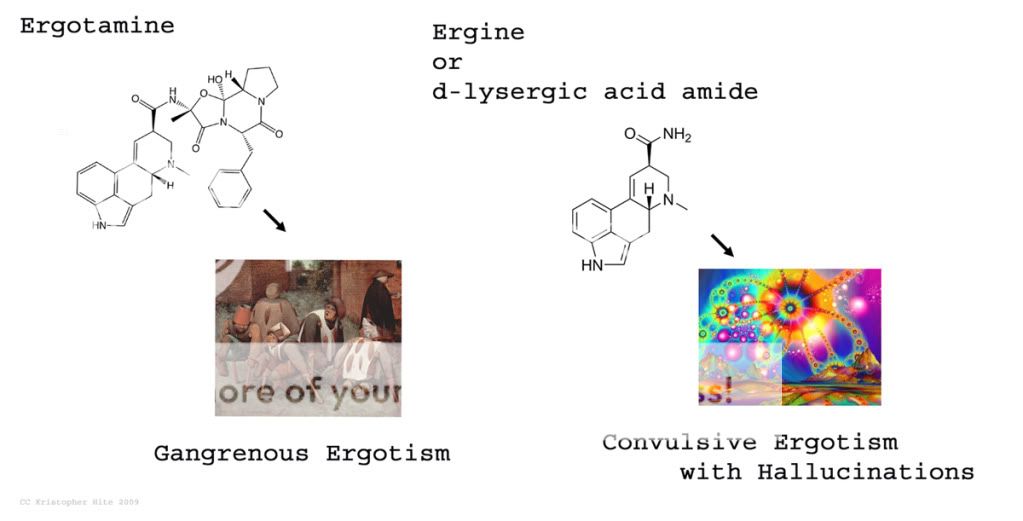
Mycotoxins contained in ergot infested rye caused two distinct varieties of ergotism. These toxins are known as the ergot alkaloids, and the two classes each have separate physiological effects - gangrenous or convulsive ergotism. Ergotamine, a powerful vasoconstrictor that prevents blood flow to the extremities, is the main culprit in gangrenous ergotism. Whereas ergine and lysergic acid hydroxyethylamide cause convulsive ergotism. These lysergic acid compounds have 10% the activity of the infamous psychoactive drug -LSD. Both LSD and the ergot alkaloids induce hallucinations by a similar and yet poorly understood mechanism. These compounds bind serotonin receptors in the brain as they are similar in shape and size to seratonin. It is not known how this induces hallucinations, but it is thought that agonist activity to serotonin releases higher concentrations of the neurotransmitter glutamate in the brain's cortex, exciting neurons in random ways. This would explain the varied psychological effects reported by individuals under the influence of this class of drugs.
By their activity, these compounds were known long before their chemical makeup was uncovered. Ergotamine had been used for nearly two centuries in midwifery to stop hemorrhaging after birth and also to induce abortion. In the first half of the 20th century the other ergot alkaloids were probed for other uses such as blood pressure and migraine treatments. A young chemist named Albert Hofmann, working for Sandoz pharmaceutical company in Basel, Switzerland, literally stumbled across LSD while performing organic synthesis of ergot alkaloids. His wild bicycle ride is a story of scientific lore worthy of its own post.
But here we are focused on the science behind medieval bewitching. The connection between ergotism and witch trials was first proposed by Linda Caporael in 1976 where she hypothesized in the Journal Science that Ergot could have been the real-world cause of the supposedly supernatural events that transpired in the village of Salem, Massachusetts in 1692.
In her paper, Caporael outlines the evidence for convulsive ergotism being the scourge that set off the string of hangings accompanying the infamous witch trials. Mainly, she points out that the symptoms of ergotism -spasms, the sensation of ants crawling under skin, and the feeling of being disemboweled - were all recorded by the court clerk when taking the testimony of the affected teenage accusers. Indeed, the very fact that the accusers were female and in their teens also implicates ergotism, as these are the most susceptible individuals in any community where there is an outbreak. Lastly, she turns to the geographic distribution of the bewitchment. Here she reconstructs a map of Salem village, where she hypothesizes that a contamination of grain grown on the eastern bank of the Wolleston river could have been the only source of ergot and still affected all the families involved.
Less than a year after her paper was published, skeptical scientists came in to refute her claims. Spanos and Gottlieb assert that Caporael is incorrect in her hypothesis and they give several reasons. They report that more townspeople should have shown signs of convulsive ergotism, that the afflicted girls did not testify to having exactly the same kind of symptoms expected from classic ergotism, and the town likely did not have a vitamin A deficiency that normally accompanies convulsive compared to gangrenous ergotism. Reading these rebuttals, there is no hard evidence in either direction which explains why this Science paper has not been retracted.
Despite this disagreement, Caporael's work inspired Mary Matossian to conduct further investigations into the possible connection between witch trials and ergotism outbreaks throughout the Middle Ages up until the 19th century. In her book Poisons of the Past Matossian lays out an incredibly convincing argument that outbreaks of ergotism indeed correlate to increased incidence of witch trials. She explains how tree ring data taken by x-ray measurements of tree ring density compiled for every year from 1269 - 1977 C.E. can be compared to an annual index of number of witch trials with statistical correlation in southwestern Germany and the Swiss alps.
Years where the growing season was cool and wet correspond to thicker tree rings and therefore seasons in which the amount of fungus growing amongst the rye was high. These long wet seasons directly preceded autumns with more witch trials. Like the medieval trials the Salem affair was also preceded by two years of unusually cold spring weather. Though there is evidence for a connection between ergot and witch trials in both Salem and the multitude of trials that took place in Europe throughout the Middle Ages, the evidence is stronger for the latter. In 2000 Alan Wolf, writing from the Harvard Medical School, further put the cabash on the Salem ergotism hypothesis. But if Carporeal had never posed the question, the work of Matossian may never have been conducted.
Further evidence for medieval outbreaks of both gangrenous and convulsive ergotism in Europe during the 16th century can be taken from a contemporary reporter. Transcending language and centuries the oil paintings of Pieter Bruegel the Elder give us an unusually clear window into recent human history. In the ergot alkaloid figure above a painting titled "the beggars" depicts peasants in what is now Belgium in the mid-1500s begging for food with stubs for limbs. Considering the geography and timing of these depictions, it is not difficult to imagine that these poor souls are suffering from gangrenous ergotism. Following his brush further we see in the 1562 painting below the story of Dull Gret or "Mad Meg" as she is known in English. Leading a band of paranoid peasant women, she storms the gates of hell, armed with cooking utensils, fearful that Spanish soldiers will pillage her village. "Mad Meg" of Flemish folklore may be under the influence of lysergic acid compounds found in Ergot!

When the imagery of Bruegel is conjured into mind, one can't help but wonder if generations of creative medieval minds weren't unwittingly dosed with background levels of the psychoactive components of Ergot.
As Samhain approaches, it is good to contemplate the possibility that some of the most infamous characters of all Hallows Eve may indeed have had very real biochemical origins.
I would like to thank Nick Clark for our many discussions and collaboration on this topic, and George Hudler for his kind advice and additional references and PowerPoint slides.
HUDLER, GEORGE W. Magical Mushrooms, Mischievous Molds. Princeton University Press, 1998. JSTOR, https://doi.org/10.2307/j.ctvs32r8v. Accessed 30 Oct. 2025.
Matossian, Mary Allerton Kilbourne. Poisons of the Past: Molds, Epidemics, and History. United Kingdom, Yale University Press, 1989.
Caporael, L. (1976). Ergotism: the satan loosed in Salem? Science, 192 (4234), 21-26 DOI: 10.1126/science.769159
Schweingruber, Fritz H., BrÄker, Otto U. & SchÄr, Ernst (1979). Dendroclimatic studies on conifers from central Europe and Great Britain Boreas, 8, 427-452
Schweingruber, Fritz H., BrÄker, Otto U. & SchÄr, Ernst (1979). Dendroclimatic studies on conifers from central Europe and Great Britain Boreas, 8, 427-452
Subscribe to:
Posts (Atom)